Sunday, September 1, 2013

Remake: We Aren't What We Were

It's been a little while since an acclaimed horror movie that wasn't made in the United States got an American remake, and now…just now…as I'm typing these words…I'm realizing maybe for the first time how much of an expression of cultural privilege the idea of a remake is, as if it's only the United States that can't seem to watch the same fucking movie the rest of the world did.

Which isn't to say that there isn't a market or appreciation for movies not made in the United States here in the U.S., there definitely is, but there's definitely this feeling at some level of the film industry that the movie doesn't "count" until it gets its American remake. Maybe that's a function of the everyday American moviegoer not "getting" it and expecting to have everything handed to them in cinematic language they understand. Maybe it's the idea that the American version will somehow always be "better", even when it really, really, isn't. I'm not sure it's not any more depressing that any other number of things about the film industry in the United States, and I probably should have twigged to this a long time ago, but there it is.

Believe it or not, that's not the main point of this post. That just sort of popped into my head as I started writing.

What I wanted to talk about was the upcoming remake of Somos Lo Que Hay, remade in the U.S. as We Are What We Are. I'm not someone who believes that the original is always good and the remake is always bad, though it does bum me out that movies don't always get the audience they deserve until they're remade (see above). Remakes vary in quality and in the degree to which they depart from the original. You've got cases where the remake shifts things just enough to take advantage of cultural differences in the audience ([REC] to Quarantine comes to mind), others where you get bigger changes that still preserve what made the original good, even when the narrative departs significantly (Ringu to The Ring), and instances where the remake manages to completely betray the heart of what made the original so good and make you wish movies never got remade (Spoorloos to The Vanishing). So there's a fair amount of freedom in what it means for something to be a remake.

We Are What We Are caught my attention because it looks like it's pretty much telling the same story, but inverting everything else about it.

The original is the story of the sudden death of a family's patriarch, and the attempts of his family to maintain their way of life in the wake of his death - it's a story of mounting desperation, as the rest of the family attempts to fill the role vacated by the father and secure the necessary materials for an undescribed ritual before the clock strikes midnight. The family lives in Mexico City, and the dead father leaves behind a wife, a daughter, and two sons who jockey to pick up where he left off to keep the family alive. The remake relocates the family from urban Mexico to a rural part of the United States, and it is the mother who dies, leaving behind a husband, a son, and two daughters.

These seem like very simple changes - just flip adjectives and there you go - but having watched the trailer, it really does change the entire feeling of the film. Setting it in the country frames it less in terms of poverty and running out of time and options, and more in terms of an attempt to maintain a way of life against encroaching civilization. I'm curious to see what reversing the genders of the family does, because a big part of the original dealt with the construction of masculinity, and I don't know if it'll be the same here. Finally, the original's less about what the family does and more about how the father's death fractures them and makes them question themselves and their place in the world. I'm curious to see how much of that is preserved in the remake, because the trailer makes it look (as it probably should) like a more traditional horror film, cutting back and forth between the family and the people in the community who begin to put some puzzle pieces together in the wake of the mother's death.

Honestly, I think that's for the better - one of my criticisms of the original was that although it had some interesting things to say about gender roles, it wasn't scary. It wasn't so much a horror movie as a drama with horror tropes slapped on top. The trailer for the remake puts much more focus on the idea that there is Something Wrong with this family, and there's lots of thunder and lightning and menace seething under the surface. I'll be interested to see if they're able to pull it off.

Friday, August 2, 2013

More Hiatus

Well, the life upheavals to which I referred a few posts ago haven't subsided as much as gotten significantly worse over the last month and a half. As it stands, I don't have the energy, mental resources, or emotional strength to have anything interesting to say about horror films right now, and probably won't until sometime in the fall. Again, I'm not abandoning the blog (I have notes for posts on V/H/S/2 and The Lords of Salem and some really good stuff on deck), but there are things going on in my life right now that are taking all of my time and energy, and just getting through the day is tough enough, let alone having what it takes to do this. I hope you'll stick with me, and until I start posting again (hopefully September or October at the latest), feel free to check out some of my older posts.

Friday, June 7, 2013

The Tall Man: Fractured Fairy Tales

I recognize that my definition of horror is much looser than most people's, and that's mostly a conscious decision on my part. I don't like the idea that the themes and imagery with which horror films play should be prescriptively confined to a genre, nor do I like the way that genre classification is used to marginalize and delegitimize films along class lines. Horror belongs to everyone and everything, as far as I'm concerned.

One example of how this can be problematic is the occasional dissonance between a film and how that film is presented. One recent example might be Cherry Tree Lane, which is a well-acted, nuanced, utterly unsparing chamber drama about class divides told through the story of a home invasion. It's quite good and I'd recommend checking it out. However, the advertising makes it look like some kind of slasher film, which it really, really isn't. 

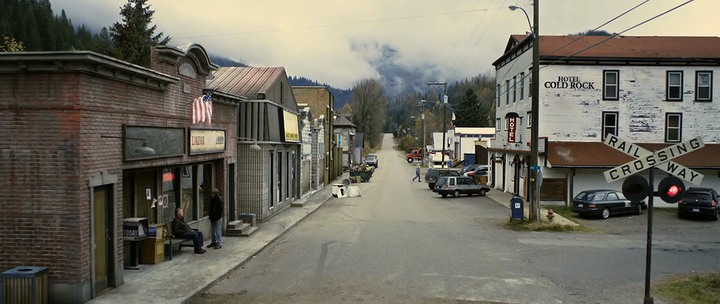
The Tall Man is another example - it's billed basically as a monster movie, but it really, really isn't. If anything, it's a fable or fairy tale. One could be forgiven going into The Tall Man for thinking it's going to be a monster movie - the premise suggests it, and it's directed by Pascal Laugier, who directed the excellent (and utterly monstrous) Martyrs. And fables and fairy tales sometimes have monsters in them, but they're not really the point. The point is what the monsters have to say about the world in which they exist.

Julia Denning is the closest thing the town of Cold Rock has to a doctor. Which is to say that she's a nurse, her deceased husband was the town doctor, and Cold Rock is a dying mining town with little to offer the people who remain. As the movie opens, she's delivering a child into the world - it's a problematic pregnancy, the child might not make it. The mother is in her teens, almost a child herself, and she's been brought to Julia because the nearest hospital is too far away, and the girl's own mother doesn't want to attract too much attention to the child. In addition to deep poverty and a rapidly dwindling population, the town of Cold Rock has a secret: One in awhile, a mysterious figure known as The Tall Man kidnaps a child from the town and spirits them away, never to be seen again. 

Not only are these people losing their way of life - their past and present - but they're losing their future as well. A pall of melancholy and dread hangs over the town like a toxic cloud. Julia is doing the best she can for these people - she genuinely cares about them and gets frustrated when they don't do the right thing, when they continue to make bad choices, to put their lives at risk. She has a child of her own and a friend who looks after him when she's gone. She's suffered loss of her own before, and she's trying to make it work in a town ruled by superstition and irrational beliefs, because these people have nobody else. 

And then, one night, The Tall Man comes and takes Julia's boy away from her.

What follows is a mad, headlong chase down one rabbit hole after another. The premise really is just the beginning, and the less you know about the story going into it, the better. That said, it isn't a monster movie, not in any conventional sense. It's beautifully shot - the decaying remains of a company town in the Pacific Northwest, grudgingly little sunlight pushing its way through the clouds, the warm golds of Julia's home, the shadows in the forest and the old mines, the cold, sterile light of hospitals and jails. Where these people are at any moment is telling us as much of a story as the events playing out before us, and those events tumble and spill and upend each other at every turn. As in Martyrs, Laugier does an excellent job here not just of communicating the pain and sadness with which these people live, but also forcing us to question our understanding of the world in which these people live over and over again. Nothing is what it seems, but everything is what it seems at the same time.

The Tall Man is a fable, a story about how and why things are the way they are, and how they should be. Julia's journey keeps her (and us) off-balance every step of the way, and though in the end we know what has happened and why, how we're supposed to feel about that is left hanging in the air, the last lines of the film a question, inviting us to ask ourselves what it is we've just witnessed.


Saturday, June 1, 2013

The Innkeepers - Spaces Between

The composer John Cage once wrote a piece called 4'33, consisting of four minutes and thirty-three seconds of silence. It can be interpreted as an artistic prank, a comment on the nature of music, the logical extension of musical or compositional theory, or an attempt to be provocative. I got to thinking about it because I think 4'33 highlights the importance of silence or space as a part of almost any creative work. Pauses accentuate sound, space highlights form, blank canvas calls attention to color. In silence and space lie all of the possibilities of what could come next, and the opportunity to contemplate what we've seen or heard. The Innkeepers makes good use of silence and space to tell a ghost story that is measured and sympathetic, almost to the point of being sad.

Claire and Luke work at the Yankee Pedlar Inn, a historic hotel in its last weekend of operation. Their boss has already taken off, most of the hotel's rooms have already been stripped, and they have exactly three guests for the weekend. It's going to be a long shift, and they've got a lot of free time to fill. Luke is trying to get a ghost-hunting website up and running, using legends surrounding the Yankee Pedlar's own ghost (a spurned bride named Madeline O'Malley) to kick it off. So he and Claire are spending a bunch of time trying to pick up ghostly voices using recording equipment and trying to record ghostly manifestations. They're also occasionally taking care of the few guests they have and spending the rest of the time engaging in the sort of aimless, time-wasting banter universal to any customer service job. As the weekend wears on, strange things start happening, little by little - sudden drops in temperature, faint voices - and one last mysterious guest checks in, insisting on the now-closed honeymoon suite.

If this all sounds very small-scale, that's because it is. There aren't a lot of musical stings and sudden zooms and mysterious figures in ragged clothes floating toward the camera. It's an almost intimate story about a place and the people in it at a very specific moment in time, and how those things evoke something larger than the sum of their parts. It's an intimate story made up of long stretches of nothing interrupted by moments of something, like a spare melody being played very slowly, leaving plenty of room to let the notes hang in the air. 

There's more humor than you'd expect as well - Claire and Luke are very much the prototypical slackers in low-level service jobs, and though both aspire to something better, this movie captures them at a point in their lives where that hasn't happened yet, and much of their interaction consists of the sort of acerbic humor common to any service industry job, born out of the need to amuse yourself during stretches of downtime, with your customers (and their attendant frustrations) as your primary source of material. They have the camaraderie that comes with that sort of work environment as well, and you can see them edging toward some more honest form of connection as the movie goes on. It isn't critical to the story, but it feels true, and when bad shit starts happening (as it must for this to be anything remotely resembling a horror movie), it's the humanity we've seen up to that point that highlights the bad shit as silence highlights sound.

And when bad shit starts happening, it begins with the hotel itself. The Innkeepers does a very good job of capturing a sense of place and setting a mood early on. By having two people working an extended shift at a mostly empty hotel on the eve of its closing, you get the creepiness of an empty house multiplied by the singular loneliness of the overnight shift at pretty much any job, and it's the hotel's last weekend, which adds a certain sadness as well - the sadness of something once full of life coming to an end of its own. The hotel is dying, and its last employees and guests are ghosts of a sort as well. Every hallway and every room is really, really empty, so when they aren't, when there's something there, or something makes a sound, it's startling. 

This minimalist approach doesn't always pay off - there may be a little too much space between tense moments, or a little too much humor and humanity, and the sense of unease that's been built up by the more mysterious goings-on tends to dissipate, and ultimately it probably lessens the impact of the climax a little as well. Still as an exercise in atmosphere and commitment to a more deliberate approach to horror that forsakes sensationalism for building toward a payoff over the course of the entire film, it's very much worth considering. Director Ti West's previous long-form effort, The House of the Devil, had a similar slow-burn approach (and a different set of strengths and weaknesses), and I suspect that with each film, West is getting closer to something that's going to be an unqualified success. So I'll let this one hang in the air, contemplating what I've just seen and wondering what's going to come next.

Saturday, May 25, 2013

How I Would Have Done It: The Final


(What I'd like to do in my How I Would Have Done It posts is examine a movie that I think didn't live up to its potential and, well, talk about how I would have done it if I'd been the writer or director. Mostly because just leaving it at "that was dumb" or "that sucked" is kind of unsatisfying, especially when there was something really good buried in there somewhere. I'll be discussing story elements in detail, so all kinds of spoilers await.)

The Final was the first movie I ever considered as the subject of a How I Would Have Done It post, way back almost 3 years ago when I first started writing this little thing of mine. The experience I had watching it could be summed up as "So…this kind of sucks. It kind of sucks, and it doesn't have to." It was the first time I found myself watching a film and thinking of specific ways it could have been improved. There's a good idea for an intense psychological thriller here, but it's buried under some sub-Saw bullshit and baffling pacing choices. The Final is a movie about the fucked-up things that teenagers do to each other, and there's a lot of potential there that the filmmakers eschew for a bunch of torture set pieces.   The real scary thing in this movie isn't all of the gory atrocities visited upon the popular kids, it's the ease with which teenagers are capable of doing terrible things, and how quickly events spiral out of control.

More Reasons to Hate Franchising

So there's all the ones I talked about in terms of why sequels suck and why exploitation of a sub-genre sucks.

There's another one: It takes the attention off the creators of the work and puts it on specific elements of the work itself - not the work, but pieces of it.

This ties in to the basic problem with sequels - whatever is seen as the most marketable aspect of a film becomes, over multiple iterations, its most defining feature. Over time, the Saw films become nothing more than showcases for increasingly elaborate traps. The Nightmare on Elm Street films become showcases for a wisecracking bogeyman who kills teens in increasingly surreal ways. The Hostel films become showcases for increasingly baroque staging for torture and murder. The people - you know, the element of the story that allows us to connect to and engage in the story - recede into the background in favor of the one thing that can remain unchanged between movies, the organizing principle around which a marketing campaign can be built. This is why sequels are, more often than not, increasingly shitty.

Maybe because of this (and what ends up being diminishing returns for some properties), maybe because it's really difficult to convince studios to back challenging, original genre films (though, mercifully, pretty easy once the film's been made and they don't have to pay for production to get them to snap up the rights to it), more and more old properties are being cannibalized for remakes, reboots, re-imaginings, whatever. It's basically a do-over. You go back to the structure of the original film, the one that was good/successful enough to inspire all of the sequels, try to strip away all the stuff that dates and limits it, and throw it back out there and hope you preserve enough of what made it good/successful to make it profitable all over again and maybe…just maybe…get a whole new franchise out of it. Sometimes it works out pretty well (The Ring, Halloween), sometimes it doesn't (A Nightmare on Elm Street). And so now there's another mystery to ponder…these movies did well originally, what could possibly have been missed in the remakes that bombed, and what went right in the remakes that did well?

Well, I don't know, how about THE PEOPLE YOU HAD WORKING ON THEM?

The decision about what kind of movie gets funded is made by producers and studio heads. The movies themselves are made by writers, directors, actors, cinematographers, costume and set designers, sound designers, lighting designers, and all of the people who work for them. Some jackass could give the green light to a remake of, oh, I don't know, Invasion of the Bee Girls (which if you haven't seen it, is right up there with Blue Sunshine as transcendently cheesy and awful movies go), and depending on who actually made the movie, it could come out well - as a sendup of or even homage to exactly the sort of movie it was to start with, as a highly-stylized period-appropriate film played straight, or a modern take that could actually be really fucking scary. On the other hand, it could come out really poorly, as an empty bag of clichés and dull gimmicks interchangeable with any other slasher film. It all depends on the quality of the script, the ability of the actors, the vision of the director, and the design of the whole production. 

So here's my point: Instead of focusing on franchises, why not focus on people who are actually good at what they do and let them make good movies, franchised or not?

I have a pretty simple heuristic: Is the movie being advertised as "from the writers/director of…(some movie I really liked)?" It's probably worth a shot. Is it being advertised as "from the PRODUCERS of…(some movie I really liked)?" Yeah, it's probably going to suck. Neither is foolproof. Great writers and directors make bad movies, and people who fund good movies do, on occasion, fund other good movies. But I'd argue that it's the people actually making the movie who have more impact on the movie's final quality. Good producers know how to manage the money and work with the people making the movie to make sure it gets made on time and to (or under) budget, and that's absolutely vital, but cinematic history is littered with examples of producers thinking they're writers or directors and fucking it up for everyone. Great writers and directors can make wonderful movies, but man, some of the decisions they make in terms of time and budget can be mind-boggling. So it's probably better for everyone if the producers handle the money and the creative team handle the the moviemaking. 

That said, I can sort of understand why some producers feel the need to play writer/director - it's the people who make the actual movie who get the attention. Nobody's writing critical essays on the contributions of Jon Peters or Harvey Weinstein to film (except maybe in a "oh you horrible bastard" sort of way). Producers don't get their own retrospectives. But instead of trying to turn themselves into the people who get all the attention, maybe they and studio heads should recognize the value of this attention and use that as a way to sell a wider variety of properties with less chance of going stale over repeated iterations because let's face it: Actors have broad followings, directors have more focused followings, and film writers have smaller followings, but they all have followings, no matter what property it is on which they're working. 

It's not even like this is unheard of among horror enthusiasts. All kinds of directors have devoted followings among horror enthusiasts, so I'm sort of baffled by why studios don't take advantage of this more. From a bottom-line perspective, maybe the franchise name really does bring more people in than a director's name does. I think that's dumb, but dumb money spends just like smart money does, so from that angle it's an easily defended practice. Still, for the sake of film, for the sake of the art upon whose back the business rests, why not diversify and capitalize on star directors and writers as much as on franchises? The broader the range of filmmaking opportunities, the more opportunity to make interesting, new, challenging films. These are good for art as well as commerce, since good movies, unhindered by the increasingly restrictive requirements of a franchise, bring people in - they bring some into the theaters, they bring some to streaming or on-demand viewing, they bring some to home video sales. Some movies take longer to become profitable than others, but in an age with so many different ways to see a movie, relying on one specific strategy for most of your movie-funding decisions doesn't make any sense. 

If, at the end of the day, it's all exercises in brand establishment, extension, and growth, why can't that apply to writers and directors? These movies, apart from being worthwhile works of art themselves, also serve as seeds for future franchises. You can only milk the same character or situation so many times, at some point you have to grow new franchises to develop. I sort of feel dirty even saying that, because I really do think franchising is bad for horror, and part of (certainly not all) why horror often does not get taken seriously as film. The more you focus on film as product, the less anyone is going to think of it as art.

And since franchising seems to be the go-to strategy, it seems like increasingly films aren't made as discrete, self-contained stories, but rather as opportunities to launch a brand, and as most recently in the case of Sinister, product taking priority over art lead to obvious aesthetic compromise, and the film was made worse for it. So instead of sending the message that if you're lucky, your film will be the first in a series of 5 or 6 that will get you a payday and maybe gigs directing some of those installment while making sick bank for the studio, send the message that if you're lucky, your film will be the first step to making you a household name among horror fans, giving you the chance to make all kinds of crazy movies and make them well, all while making sick bank for the studio. 


And if you bitch about the dearth of good, original horror movies? Think twice before going to see (Movie Title) (Number > 1), because when you do that, you're telling the people who decide what kind of movies get funded and/or distributed that franchising works.

Friday, May 17, 2013

Not Dead, But Dreaming

Just a quick note to say that this blog is by no means dead, but I'm currently digging out from under a pile of hideously busy month at work, personal upheaval, and computer going kablooie. I hope to resume regular posting shortly, but in the interim, I'd like to point out that Kill List, one of my favorite movies of 2011, is now available on Netflix, so go get that shit. For that matter, so is Snowtown (a/k/a The Snowtown Murders), so go get that shit too.