Wednesday, July 14, 2021

Blair Witch: We Faked It Because It’s Real

 (This one’s probably going to be pretty spoilery for The Blair Witch Project, so if you haven’t seen that and are planning on it - and I would definitely recommend it, it’s really good - maybe hold off until you’ve seen that film.)

Some time back I wrote up one of my favorite horror films, The Blair Witch Project, which was striking (and profitable) enough to essentially kick-start found-footage as a narrative approach to horror film. It was lightning in a bottle - coming at just the right moment in the zeitgeist, using techniques more common to theater than film, and leveraging the still-developing Internet for a publicity campaign that profited from an audience’s credulousness to build up a lot of hype ahead of time. William Castle would have been proud. It wasn’t the first found-footage horror film, but it was certainly the highest-profile (and most profitable) one. Did I mention it was profitable? It was profitable. And the thing about profitable horror films is that studios invariably want to capitalize on them to keep the revenue stream going - sequels, prequels, reboots, franchises, whatever. Do it again, it worked the last time.

But here’s the thing - you can’t really capture lightning in a bottle twice, as demonstrated by Blair Witch, a 2016 sequel to The Blair Witch Project. This film attempts to recapitulate the original, but in doing so misses so much of what made the original film good. Instead, it manages to fall victim to all of the found-footage film cliches that emerged following the originals’ success and ends up being an inchoate, formulaic mess.

This film is about James Donahue - the younger brother of the original film’s Heather. He’s never really gotten over his sister’s mysterious disappearance 22 years ago, and he still holds out hope that she’s still alive somewhere. He’s even got Google alerts set up for things to do with her disappearance. Usually they don’t pay off, but then one day he gets an alert for a video uploaded to YouTube, taken from a cassette some people found in the Burkittsville woods. It’s grainy and shaky and degraded, but it appears to have been shot inside of a very old, very abandoned, very familiar house. Someone’s running through hallways, bolting doors behind them, and then there’s a quick glimpse of them in a mirror…and it looks like it could be Heather.

And that’s all it takes - James, his girlfriend Lisa, his best friend Peter, and Peter’s girlfriend Ashley gear up to head into the woods to look for her.

The footage we’re watching, we’re told, was recovered after the fact from DV cassettes and video capture cards found in the forest.

This is actually the second time someone’s taken a grab at the brass ring. The first sequel - Book Of Shadows: Blair Witch 2 - wasn’t really a success either. There was apparently considerable studio interference with its production, and the end result is gimmicky and kind of incoherent. If you told me that it was an original screenplay retrofitted as a Blair Witch movie I’d have no trouble believing it. It did, however, make a couple of smart choices. First, it was shot as a conventional narrative, not as a found-footage film. Second, it didn’t attempt to re-tell the original story, instead being about a bunch of tourists (in a world where the movie The Blair Witch Project exists) who go camping in the Burkittsville woods, lose a bunch of time, and subsequently have to reconstruct what happened by reviewing footage they shot on their own consumer-grade video cameras. Not a bad conceit, really, and I think if it had been a stand-alone film it could have been really good.

(Now that I think about it, a film from the perspective of Heather, Mike, and Josh’s families, still haunted and traumatized by their children’s disappearances decades later, done in the style of a more explicitly supernatural Lake Mungo could be a really interesting sequel. Good luck getting that made, though.)

But those are smart choices. This film by and large does not make smart choices. This film, released 22 years later, attempts to hit many of the same beats as the original and do so in a found-footage format. What this means is that it ends up drawing less from the power of the original film and more from all of the cheap imitators that came after. A lot of the conceits and scenes that worked really well in the original mutated into cliché over time as producer after producer tried to replicate the originals’ magic, missing what made it good in the process.

To start, James and company all decide that they’re going to make a foray into those woods themselves and as it turns out, Lisa and Ashley are film students. Because of course they are. So Lisa’s going to make a documentary about it. And so here we have cliché #1 - there’s no reason this has to be a documentary, but that provides a pretext for the omnipresence of cameras to capture everything. It made sense in the first film because the whole story was “film students go into the woods and don’t come out.” The whole reason there was a film was that these people were in the woods to film things. But subsequent attempts at found-footage films try to take other stories and shoehorn in reasons for the protagonists to be recording everything, whether it makes sense or not. Next on the cliché list is the obligatory tech rundown, including a drone camera and miniature earpiece cameras with built-in GPS. This is another thing I see a lot in mediocre found-footage films - a lot of fuss and detail made over the big arsenal of recording equipment and multiple cameras the protagonists have.

This has never struck me as anything more than a cheat - the original film shot everything using two cameras and one mic and DAT recorder for sound. That’s it. The whole point is that our perspective is imperfect and incomplete, but a lot of films miss that point and instead do everything but find a reason for one of their characters to just happen to be wearing a Steadicam rig. And then on top of that, there’s a segment where they go out clubbing while wearing their earpiece cameras for…reasons? In The Blair Witch Project, there’s a brief segment where the three of them calibrate the cameras while they’re drinking in their motel room, but that seems to have mutated into a need to have a scene in every found-footage film where everyone’s out partying while recording and it almost never makes any sense at all. It consistently misses the point that those elements made sense in the context of the original film, and mistakes them for obligatory gestures.

Another problem with this film (common to found-footage films) is that at no point does it feel like anything but a movie. The first film worked so well - as a horror film and as an example of found-footage film - because it was naturalistic in the extreme. Dialogue was almost entirely (if not entirely) improvised, it was shot on location, the actors were only given a daily outline of what had to happen in the course of the day’s shooting. How they got there was up to them, and their environment was manipulated to make their discomfort and exhaustion real to a degree. The whole thing was closer to improvisational theater than to filmmaking. By contrast, this film was entirely scripted, and it shows. The dialogue isn’t especially wooden or anything, but it definitely sounds like dialogue and not naturally occurring conversation. The emotions don’t feel as real or as raw either, with some exceptions toward the very end, but even then it’s sort of too little, too late. It’s not impossible to write dialogue that sounds like actual conversation and it’s not impossible to get performances that feel extremely naturalistic, but it’s a lot tougher than just writing a script, and I think there’s a certain suspension of disbelief that we employ when we’re watching conventional narrative films where we don’t necessarily expect naturalistic performances and dialogue. There’s a tolerance level for a certain amount of staginess. But if what we’re watching is supposed to be raw footage pulled from an amateur’s camera? Any staginess sticks out like a sore thumb. At no point does the dialogue or the performances feel like anything but a movie.

Arguably, any given film should succeed or fail on its own merits, but not only is this film a sequel to another film and thus inviting comparison on that basis alone, it also goes out of its way to try and replicate beats and moments from the original. The pretext here is that we’re watching footage recovered from a bunch of DV tapes and video capture cards discovered out in the woods, just like in the original (and like the original, this information is communicated in stark white-on-black title cards that aren’t the only instances of homage, but they’re probably the least distracting). And just like in the original, once our protagonists get into the woods everything starts to go wrong. Some of it goes wrong in exactly the same way it did in the first film, which doesn’t really work because we’re expecting it. What’s startling the first time is anticipated the second. Some of it goes wrong in far less interesting ways than the original as well. The filmmakers don’t just stop at having unseen forces menace the protagonists, as the film goes on they also include briefly-glimpsed monsters and body horror, all slathered over with a thick layer of jump scares. A big part of why the original worked so well was because it established a mood first, and took its time doing so. As a result, even the slightest strange thing - mysterious cairns, stick figures hanging from the trees - carried with it a real sense of dread. Here, they’re just sort of set dressing, a way to say “hey, remember this?” and just in case that doesn’t do the trick, every other horror cliché you can think of gets chucked in as well. This is not a film that builds a mood so much as it just keeps turning up the volume louder and louder in an effort to scare us.

That’s yet another way in which it’s in strong contrast to the original. The Blair Witch Project was a relatively quiet film, low-key, with tension simmering gradually over its runtime so it wasn’t really until the last act that things started getting intense. It was relatively quiet visually as well - lots of long, quiet shots, shots held on people’s faces, footage of the forest itself. This is not a visually quiet film - the footage is constantly interrupted by glitches (except when it isn’t, and then it’s often shot from angles and with a steadiness that shouldn’t have been possible with the camera equipment they had, which is awfully convenient), scenes invariably end with a blast of interference, someone yelling at someone else to turn their camera off, or the camera crashing to black. Lots of the footage, especially in the third act, is shot on the run while people are bolting through the woods screaming at the top of their lungs. It ends up being more irritating and distracting than anything else, a barrage of imagery that never really coheres.

There are a couple of things it does do well, to be fair. James and company make contact with Lane and Talia, two sketchy locals who uploaded the footage in the first place, and they ask to join up as our protagonists head into the woods. There’s tension there - you’ve got four city kids who have no business being out in the woods and the two locals who take the legends about the woods very seriously. and it isn’t clear how trustworthy Lane and Talia are. The friction between the two groups works pretty well and adds some ambiguity in places that would have worked in a quieter film. .The most effective element of the film (one borrowed from the original) is the way time seems to slip out of joint the deeper they get into the woods - it’s a relatively minor element in the first film, and there was as likely to be down to increasing disorientation as anything else, but here they really lean into it in ways that work more often than they don’t. In those moments, it reminds me a little of an outdoorsy version of Grave Encounters at its best, though it also shares some climactic issues with that film as well. I think if they’d cut out some of the more blatant callbacks to the original and really made this a film about six people ending up someplace outside of time as we know it, really leaning into the desperation, isolation, and dread that come with that, then it might have worked. As it is, I think it just got included because it was in the first film (along with the cairns, the stick figures, someone who claimed to know where they were when they really didn’t, the abandoned house, all of it) and like everything else they just went bigger and louder and more obvious than the original.

At one point, a character says “we faked it because it’s real,” and I think that kind of sums up the problem. The original worked so well because its production methods emphasized realism to a degree that you don’t often find in film, and this film is very much fake in the sense of being artifice - it’s scripted, it lands on every found-footage film cliché you can think of, it leaves as little to suggestion as possible, and feels engineered from its first minutes. It’s a movie that treads the same ground that The Blair Witch Project did, but manages to forget everything that made that film so good in the first place. If it had been a conventional film narrative, well, I don’t know that it would have been good, but it would have had a fighting chance. As it is, it’s so clearly fake that it inspires nothing but annoyance.

IMDB entry
Available on Hulu
Available on Amazon


Thursday, July 8, 2021

The Dead Center: The Cinematic 7-10 Split, Redux

In the course of writing this thing, I’ve run across a fair number of films that don’t land as well as they could because their ambitions outstrip their budget. So-called “genre” films (as opposed to “serious” films, which usually means “drama,” which is in no way itself a genre, no sir, whoops got carried away there), whether they’re horror or science fiction or fantasy, generally don’t get lavishly funded once you step away from the blockbuster exceptions, and they’re also the ones pushing suspension of disbelief the hardest. So they’ve got to work harder to maintain audience buy-in to their conceit, and do it with fewer resources than your garden-variety drama.

To my mind, then, the most effective low-budget horror films are the ones that don’t try to go too big by relying on effects-heavy setpieces that they can’t afford to pull off convincingly. I’m also sort of biased because I think I’ve established to a tiresome degree by now that I think good horror is more about mood and atmosphere and caring about the characters than gore or showy special effects, and those are things you don’t need a big budget to get. Case in point: The Blair Witch Project cost $60,000 to make, and I’d argue it’s better and scarier than films that cost more than 100 times that.

So, long story short, I’m here for small-budget indie horror because when it’s good, when the people making the film know what they’re doing, its constraints lead it to embody what I consider to be virtues in horror film. The Dead Center is a good example of this - it’s subdued, realistic, and suitably creepy. It’s not without its problems, but it works really well within its limitations.

It’s been a long day for Dr. Daniel Forrester, but you get the sense that every day is a long day for him. He works in an emergency psychiatric care ward, and he cares probably a little too much. He’s the kind of doctor who bends the rules in an effort to make a difference, and he’s just discovered that it’s cost him his admitting privileges - he’s authorizing more extended stays than their budget can sustain, all because he wants to help everyone, damn the cost. And on top of that, they’ve just gotten an odd new referral - a John Doe who just sort of…showed up…in the main hospital, with no memory of who he is or how he got there.

It’s also about to be a long day for Dr. Edward Graham. He’s with the medical examiner’s office, and he’s been called to the same hospital to do an examination on an apparent suicide victim…

…except that he can’t, because the body - a John Doe - has disappeared from the morgue.

The basic structure of the movie is one that bounces back and forth between Forrester and Graham, each trying to figure out what happened to their particular John Doe. Forrester tries whatever method he can to help his get his memory back, and Graham drives all over the city tracing the last days of his. The rest of the film is an exercise in convergence, as their two stories come together. By and large, it all feels very real and grounded in a way that a lot of horror films get wrong - the hospital looks and sounds like an actual hospital, the psychiatric ward a constant hum of procedure underpinned by the shouting and crying and screaming of people in acute distress, the staff calmly going about their business, swimming through bedlam. These people really feel like they’re professionals tasked with an extremely difficult job in emergency psychiatric medicine and not the caricatures of doctors and nurses populating film and television, and it goes a long way toward selling everything that happens next.

This extends to the rest of the cast - everyone talks and acts like human beings, there’s very little outright exposition and for that matter, some cliches are nicely subverted. Forrester is very much the wild-card doctor who doesn’t play by the rules, and we see this more in his actions than in speeches, which is nice. But normally that character is played as the hero, as the one who was right all along, but here he pretty much keeps fucking everything up, which is what actually happens when you think you’re above procedure or that what you want outweighs everything else. And the administrator who is tired of his bullshit isn’t a soulless unfeeling functionary, she still has a considerable degree of empathy for him and doesn’t appear to relish what she has to do in response to his antics. She doesn’t seem like the rigid control freak this character usually is, she seems like someone who has to think about the big picture and has responsibilities that Forrester doesn’t. People talk in this film, they don’t make speeches, and the portrayal of the mentally ill strikes me as much more real and human than most films manage. As far as the world and the people in it, there were few false notes, with a couple of exceptions I’ll talk about more in a bit.

This naturalistic tone extends to the horror elements as well. The effects work is minimal, restricted to a little prosthetic and makeup work that highlights the unnaturalness of what’s going on without tipping over into rubber-suit territory, and some quick, almost-subliminal shots and sound work. Combined with a good sense of staging and editing, the film gets a lot of mileage out of very small gestures- flickering lights, open doors, the sound of gasping - that works very well in context to create a sense of dread that escalates as the film goes on. It’s good at giving us just enough to feel uneasy without overexplaining, relying instead on suggestion and picking its more dramatic moments carefully, building things slowly until the shit really hits the fan in the third act. The film is shot using lots of natural lighting, and music is used very sparingly to highlight specific moments. Even more impressive to me is the way other moments are well-served by silence employed to equally dramatic effect, so this isn’t a film with an intrusive soundtrack problem.

It’s got a good sense of scale as well - moving from Forrester and the interiors of the hospital to segments of Graham out and about in the city doing legwork, alongside aerial overhead shots of the city and traffic, serves to locate what’s happening in this one place, this single hospital, in a much larger setting. The film opens with a slow, almost languid overhead shot of an ambulance headed to the hospital, sirens and flashers on, but we’re so high up and far away that it’s mostly silent, only to zoom closer and slam down into the speed and noise and chaos of an ambulance with a dying passenger headed full-tilt for the emergency room. It’s sort of a nice summary of what this film is going to do over the course of its run - it’s going to start with little things, and then over time pull out and away to show you the real stakes. It sneaks up on you in that respect, and the third act gets pretty chilling as a result. The setting is quite different (well, sort of), but it reminds me a lot in tone and scope of a less-gothic Session 9 or a less-Lovecraftian Absentia. It’s not as good as either of those films, though, for a few reasons.

First, the grounding in reality works very much to the film’s benefit, but it also means that the couple of places it does depart from realism stand out pretty sharply by contrast, to the film’s detriment. It’s not really clear why Forrester has to be written as a troubled psychiatrist (and we learn that he’s troubled in a big ol’ chunk of exposition that reeks of “why is this person saying this stuff out loud to this other person like he doesn’t already know all of this?”) whose idealism interferes with his ability to do his job. It doesn’t really add much to the story and all of the same beats could be easily served by someone more professional. It’s sketched in just enough to make it stand out - in a more melodramatic picture, we’d accept someone like him right away because everyone’s sort of a caricature, hut here, where people are very much real people, it sticks out like a sore thumb even though it’s handled pretty realistically. Someone like him would have been fired a long time ago in this world, and the film isn’t entirely about him or his descent into madness, so it ends up being more distracting than anything else. As far as Graham goes, the character is just fine, pretty low-key and professional, but it’s a little hard for me to swallow the idea that a doctor from the medical examiner’s office would be able to just sort of drop everything to go chase down a missing John Doe, get access to crime scenes, and be permitted to interview people without law enforcement present. He feels less like a medical examiner and more like a detective, and that was a little distracting as well. Again, in a movie that didn’t feel so real, this would be pretty easily digested, but here it grabbed my attention immediately.

Second, there are also a couple of stumbles in how the story is laid out. The opening scene is striking, but from a story standpoint might have worked better later in the film, because it reveals an important detail right at the beginning. If  the film had opened on one story or the other, and worked in that scene later into the film, it would have hit harder. It’s another case where a mystery and gradual revelation is replaced with waiting for the characters to catch up to what we already know. and it takes some of the edge off.  And then, after a pretty unsettling third act that makes the stakes much more apparent, the very end of the film lands with a bit of a cliched thud - it’s anticlimactic and kind of obvious in a way that the rest of the film isn’t, and that’s disappointing.

Don’t get me wrong, I don’t think any of this undoes the film entirely - its low-key, naturalistic approach really benefits the film once it starts to turn the heat up, and it does a good job of building dread. It’s just a bummer when it works so well in so many ways that the shortcomings really stand out. But none of these things are a function of budget - it wasn’t like it was obvious that this wasn’t a hospital, the practical effects didn’t look cheap, the acting was solid throughout, and it created a sense of dread by getting us to care about people and then creating a vocabulary that would tell us when bad things were about to happen. Those are definite strengths that bear attending to. For its faults, I think there’s a lot to be learned from what this film does right. It’s just too bad that it ends up being a cinematic 7-10 split.

IMDB entry

Available on Amazon

Thursday, July 1, 2021

Dark Touch: Won’t Someone Think Of The Children?

It’s a time-honored technique: If you want to really freak people out, bring children into the picture. Put them in danger, put them in pain, or better yet, make them the antagonist. Nothing like a good creepy child to add value to a scary movie. Hell, we don’t even need to be talking about horror films - if you want to whip up some good old-fashioned moral panic, simply suggest that some type of film or music or literature or whatever will be dangerous for our children. The amount of self-righteous, authoritarian nonsense that gets pushed for the sake of “the children” is considerable. And that’s because it works - who wants to be the person who opposes child safety? Nobody, that’s who.

But this week isn’t really about moral panic. It’s about Dark Touch, an unsubtle exercise in formulaic nastiness that pretends to something more and fails.

It opens with sort of a false start - it’s late at night, raining, and a little girl runs out of her family’s house. She’s found outside, taken in by another family, and then her parents come to retrieve her. There’s some tense, oblique conversation, something goes unspoken and then…it’s a few years later? What was the point of that? I know I usually deride flashbacks for neatly underlining that a particular place or person is bad, and no shit, we’re watching a horror film, you don’t need to tell us bad shit is coming, but this…doesn’t even do that. It’s just a scene where a little girl runs out of her house and then gets brought back.

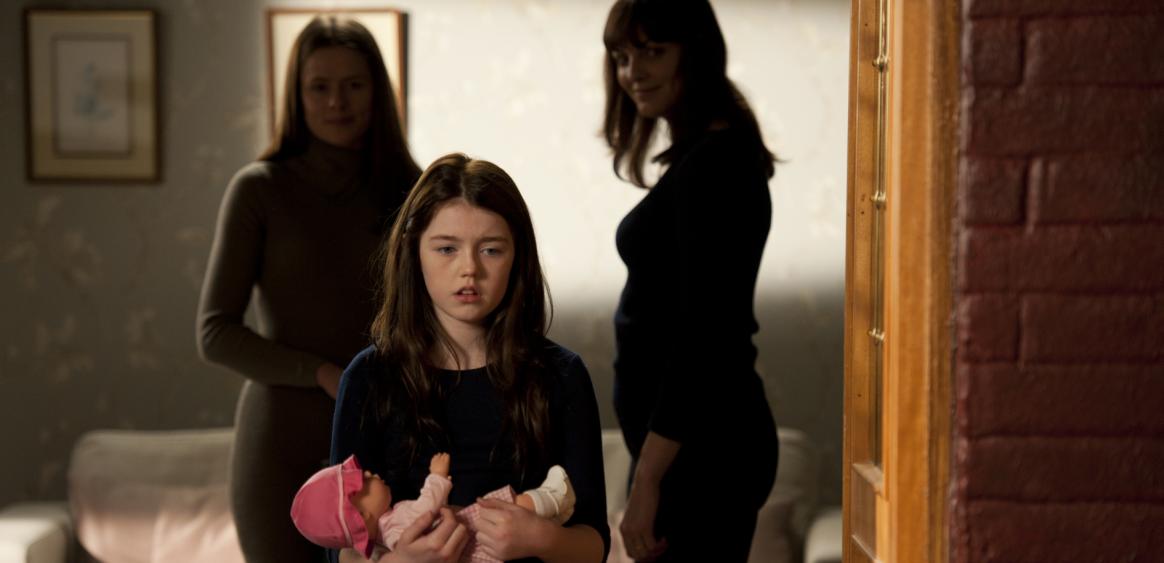
And then we cut to this little girl, a few years older, with her family. Her name is Niamh, and she and her family live in a small town in Ireland, far away from the big city. It’s her, her mother and father, and her infant brother. But it’s also here that the puzzling opening scene starts to make a little more sense. It’s the old story - a prosperous, middle-class family, nice house, cute kids, but when night falls, father goes into Niamh’s bedroom and locks the door. No wonder she runs away. And then, one night, it all goes wrong. Niamh screams at the top of her lungs, and the house rattles, objects shift. By the time it’s all over, Niamh’s parents are dead, crushed beneath heavy furniture, and the police find Niamh hiding in a cupboard. She clutched her brother so tight it suffocated him.

So, traumatized, Niamh is placed in the care of her neighbors, Lucas and Natalie. They have two children of their own and the memory of a daughter lost to cancer. It’s just until they get more permanent accommodations set up. This way she can keep going to school while the police look for the gang of vandals that obviously tore up her family’s house. And it all seems nice enough, initially, until one night when Lucas reaches for his belt in response to an errant child…

…and the house starts to rattle, and objects start to shift.

It is clear almost from jump where this movie is going. It’s weird that it tries to pretend at all to be anything other than what it obviously is, as if it’s as much in denial as the adults that populate the film. This is a story about a traumatized girl who can move things with her mind, set against a backdrop of pervasive child abuse. From the opening scene, this is a film crawling with children - infants, toddlers, pre-teens - in almost every scene. This is a small town with a lot of kids, and it becomes pretty clear that a lot of these kids are getting beaten or molested and that nobody talks about it. And now one of them has supernatural powers. So it’s also pretty clear that this isn’t about survival, it’s about revenge.

So no, there’s no mystery here - not in the soundtrack, which fills most of the space in the film with minor-key piano or buzzing ambience or swells, all intended to communicate that this is very sinister and spooky. It’s not a film that is content to let moments be. Nor is there any mystery in the basic narrative - it’s clear very early on exactly what has happened and who’s responsible no matter how much the characters in the film look the other way. What we’re left with offers no revelation, no actual horror. There’s nothing to discover, it’s very clear pretty early on exactly what’s going to happen, so there’s no tension - it’s just a matter of watching everything play out and wondering how far they’re going to push it. And as the film goes on, everything feels less and less grounded in plausibility (and the contrast between the very ugly reality of child abuse and supernatural powers makes the whole thing feel trivialized) and more and more like an excuse to do shocking things.

The film itself is equally obvious. The cinematography leans heavily into shadowy interiors and dark exteriors with few sources of external light, and the dialogue is extremely stilted and expository throughout. Combined with the intrusive soundtrack, it all has a real movie-of-the-week feel, where absolutely nothing is left to mood or inference that can’t be spelled out in the most obvious way. It does succeed to some degree early on in creating a very oppressive atmosphere by emphasizing abuse’s many forms and making it almost omnipresent, but it doesn’t last - as the movie goes on it becomes less interested in the cost of violence against children or the very real horror associated with it, and more and more interested in a supernatural riff on the “bad seed” film that uses the very serious topic of child abuse as a rationalization for violence, and that feels kind of gross to me.

It’s not that I have a problem with provocative or transgressive filmmaking in horror, far from it. But in my opinion, if you’re going to traffic in subject matter closer to taboos, you need to earn it. You need to treat the characters with a certain amount of respect, treat the topic with the gravity it deserves, and this film just doesn’t. Instead of locating the horror in the experience of victims of abuse, it ultimately uses that abuse merely as justification for everything that comes afterward. The humanity of its protagonists and antagonists alike gets lost along the way, ultimately discarded in favor of empty, escalating atrocity. It feels less like an articulation of trauma, or even of a small community’s complacency in the things going on behind closed doors, and more like an attempt to shock by pivoting all of the violence around children - either as the victims or the perpetrators - without ever really reckoning with (or even tapping into) the impact that either of those things actually has. It’s like I said, if what you’re bringing to the party is a load of bullshit, just bring up “the children” and hell, maybe that will get you over.

IMDB entry

Available on Amazon

Wednesday, June 23, 2021

Censor: Your Life Is Already Half Video Hallucination

Psychological horror does a good line in blurring the line between reality and delusion, in featuring protagonists who aren’t sure if what they’re experiencing is real or not. And horror films (alongside other forms of popular entertainment) have been singled out as inspiration for real-life violence for decades. The argument is that people cannot distinguish reality from fantasy, and so seek to reenact horror films in real life. For this reason, the argument goes, horror films should be restricted or banned, in order to protect the public. In my (cynical) experience, it’s rarely if ever truly about public safety. Generally it’s a convenient way to gin up outrage or to present someone as a moral exemplar ahead of a political campaign or a fundraising effort. It’s not about horror movies, it’s about something else. Horror movies are just a useful proxy.

Censor is a genuinely unsettling psychological horror film that directly engages with these ideas, and doesn’t insult the audience’s intelligence in the process.

It’s set in Thatcher-era Britain, the early 1980s. It’s a time of extensive civil unrest and increasing suppression. More to the point for this film, it’s the height of the “video nasty” era of film censorship, and we follow Enid Baines, a censor at the British Board of Film Classification. It’s the job of her and her colleagues to screen films, impose a rating, and recommend edits that make the film compliant with obscenity guidelines. She and her colleagues have to watch a lot of what were colloquially termed “video nasties” - exploitation films high on graphic violence and low on production value, intended for distribution directly to video rental places.

Enid is good at her job. She’s thoughtful, careful, determined to make the right decisions. She takes the idea that these films are potentially corrupting and dangerous at its word, and she’s passionate about protecting people. It’s personal for her. Her sister Nina disappeared without a trace when they were both very young. It’s haunted her ever since. And she has a lot of stress in her life - her parents are having Nina declared dead, a recent murder case is tied by the tabloid press back to a film that Enid passed for certification and so now she’s getting nasty phone calls at all hours and the press are camped outside her job. And she just finished screening a film called Don’t Go Into The Church, a film with scenes that looked suspiciously like childhood memories of hers. She would have sworn one of the actresses looked familiar too.

She looks a lot like Nina.

The central conceit, then, is that we have someone who job it is to protect people from confusing fantasy and reality finding that the line between fantasy and reality is blurring. In this sense, it treads some of the same ground as Berberian Sound Studio. Both feature protagonists in hostile environments - in Berberian Sound Studio, it’s being alone in a foreign country, and for Enid it’s being mired in the controversy around a recent classification. Both protagonists are also immersed in violent films - as part of the production in Berberian Sound Studio, and here as a viewer - and it both cases it’s taking a psychological toll. The biggest difference here is that Berberian Sound Studio was a much more restrained, cerebral film. There’s something much more disturbing about what happens to Enid as the film goes on. It’s very much a slow burn - everything starts to go sideways so gradually, beginning with nightmare segments and then the gradual intrusion of repeated motifs, the contrast between Enid’s perspective and others’ becoming more sharp as the film goes on, that you don’t realize just how far gone Enid is until it’s much too late.

Like I said last week, dealing with your nightmares by denying and suppressing them doesn’t end well, and Enid cannot bring herself to face her nightmares, to confront what happened all of those years ago, and the film, to its credit, keeps a lot of things unexplained and unresolved. We get hints, clues, possibilities, but Enid won’t admit to herself what happened, and we experience most of the film from Enid’s perspective, so we never know for sure ourselves. The possibilities, the glimpses, the stuff we get around the edges, they’re disturbing, but it’s also hard to tell how much of that is the reality of what happened and how much is Enid excoriating herself for things out of her control. Again, there are no easy answers to be had, and the interweaving of Enid’s life with both the films she’s investigating and her own internal psychological landscape is intuitive and seamless, making the final act really, really unnerving. 

The production is handled skillfully - as I said above, it reminds me a lot of Berberian Sound Studio, and that’s as much about the aesthetic as narrative similarities. Like that film it’s a period piece dominated by primary-color lighting and drab environments, longer takes that focus on the minutiae of everyday workplace behavior and highlight the ways in which the protagonist is sort of an outsider. Although the censors aren’t portrayed unsympathetically - they’re not strident moralists for the most part, they’re doing a job, and they mostly seem to have a wry distance on the films they’re watching - some of them do seem to see Enid as being a little too strict and serious about it. They’re friendly enough, but there’s a bit of a chummy boys’ club atmosphere to the place, and you get the sense that she doesn’t have too many friends. There are lots of shots of Enid on her own, walking back to her tiny, drab apartment, and even at work she’s generally pictured apart from her colleagues. It underlines an alienation that only gets worse as the film goes on.

It’s also really good at using contrasting cinematic vocabularies to describe what’s happening. Video nasties were low-budget exploitation films, high on graphic violence and low on production value, meant to titillate and shock, and they’re recreated very faithfully throughout - honestly, I’m not sure how much is recreated and how much is archival footage, it’s damn near impossible to tell. So we start with glimpses of the films Enid is screening - grainy, garish, obviously made on the cheap - and as the film goes on, their presence makes itself known in increasingly intrusive ways without being too literal about what’s happening. It’s the blurring of the line between film and reality, and it isn’t even really necessarily that noticeable until the point where you realize how much it’s swallowed up everything

It’s sort of a truism that the most vehemently moralistic have all kinds of skeletons in their own closets, but here it seems less a case of rank hypocrisy and more that this is how Enid is processing her trauma. She can’t bring herself to face what happened to Nina, she’s deeply in denial, so she sublimates it into her work as a censor. She couldn’t protect or save her sister, so she’s going to protect and save everyone else instead. But putting that level of denial in an environment suffused with violence, being constantly exposed to graphic violence as a viewer, well, those aren’t going to mix well, and in Enid’s case it makes for a nightmarish downward spiral from which we get little relief and even less closure. It’s thoughtful, powerful stuff.

IMDB entry
Available on Amazon

Wednesday, June 16, 2021

Doctor Sleep: Acts Of Service

(Just as a heads-up, I’m probably gonna spoil both The Shining and this over the course of this one, so if you have somehow never seen The Shining, go rectify that immediately and then come back to this.)

I am normally not one for sequels. I think horror works best when the audience is left hanging a little, when there are loose ends, when not everything is explained. Sequels tend to overexplain, bleeding off the mystery that gives horror its power. At their worst they create some kind of mythos for the world the story exists in, turning what should be scary into what is basically a gory action film.

So I’m already not on board with sequels, but a sequel to an iconic horror film? Come on. Come on. At that point, you aren’t just making a film, you’re also taking on the original film’s legacy. You’re making a film under a very long shadow. You’re going to have to reckon with the original, otherwise what’s the point? And how do you do that in a way that doesn’t devolve into “hey, remember how cool this movie was?” It needs to be something more than a retread, it needs to not overexplain, but it still has to acknowledge its source material.

This means that Doctor Sleep has…a lot…on its shoulders. And I don’t think it drops the ball, but I think in its attempt to be faithful to the novel from which it was adapted and engage with both the original text of The Shining and the film adaptation, it…well, it ends up being a lot of things, but I’m not sure a horror film is one of them.

It begins as The Shining does, with the same ominous, minor-key synthesizer and a long tracking aerial shot. In my write-up of The Shining, I pointed out how just changing the soundtrack would turn it into a family vacation film, and that’s exactly what we get here. The car driving the long road belongs to a family who stops for a picnic, and their young daughter Violet wanders off to pick flowers. Down by the riverbank, she meets a woman singing a lovely tune and picking flowers of her own. There’s some conversation, and soon enough, Violet has become another face on another missing-child poster.

Elsewhere, Danny Torrance is living in Florida with his mother Wendy. They moved there so they’d never have to see snow again. But Danny - cursed to see the dead around him - hasn’t earned a quiet life yet. The Overlook was condemned following the events of The Shining, and its ghosts grow hungry, drawn to Danny like moths to a candle. As he gets older, he learns ways to deal with them, to lock them in boxes in his mind, where they can’t ever, ever get out.

And then meanwhile, in yet another movie, young Abra Stone celebrates her birthday with her parents and friends. Her mom and dad have hired a magician for her birthday, and Abra - delighted - does some magic tricks of her own, much to her parents’ bemusement. She’s gifted, like Danny is gifted.

This is how the movie opens, and I think you get a sense of one of its biggest problems right off the bat. The first third of the film is almost entirely world-building and table-setting. This is even assuming we’re familiar with the original film - if you’ve never seen The Shining, it’s going to be pretty confusing, and that film had a lot going on as well - “psychic boy moves to a haunted hotel where his abusive, alcoholic father goes insane” is a lot of balls to keep in the air, and this film tacks on even more. This film employs the same title-card device that The Shining did, and it ends up being equally as disorienting, though I don’t think that was the intent - it just highlights how much we’re bouncing around in time and space trying to connect three different stories.

So we have a flash-forward. Danny Torrance is a grown man, and he isn’t doing well. He may have quieted the ghosts of the Overlook, but he continues to see the dead. He is very much his father’s son - he drinks to numb himself and has bouts of violent rage. He loses nights to booze and coke and fistfights. He sleeps on the street. And then he hits bottom in horrifying fashion, bringing together the worlds of the living and the dead. He jumps on a bus and heads for New Hampshire. He gets a room, starts going to meetings. One day at a time. He takes a job at a hospice, sitting with the dying. A big part of recovery is being of service to others.

Meanwhile, Abra has grown into an extremely bright teenage girl who can hear what other people think, who can move objects with her mind, who can reach out across vast distances to other similar minds. Minds like Danny’s.

And then there are the people behind the disappearance of young Violet. They’re a group who call themselves the True Knot. They’re very, very old. Much older than they look. The oldest of them cheered gladiators in the Coliseum. They live a nomadic existence, traveling across the U.S. in a caravan of campers, looking for the food that sustains them. They call it “steam,” and it prolongs their lives. Steam is produced when you take someone with Danny or Abra’s gifts and torture them to death. Pain makes the steam better. Fear makes the steam better. And it’s always better in the very young.

So they travel across the country, leaving a trail of missing-child posters in their wake. But it’s getting harder and harder to feed. The steam isn’t so pure anymore, and there’s less of it out there. As their leader Rose tells their newest member: “Eat well, and live long.” But it’s been a very long time since any of them ate well.

Like I said, just getting all of the pieces onto the board takes the entire first act, and then the second has to start bringing everyone together. Abra learns about the True Knot (in another genuinely horrifying moment), calls out to Danny for help, and Danny has to reckon with all of his old, buried ghosts to help keep Abra alive once the True Knot gets her scent. The chase is on.

Here, I think it’s worth contrasting the original story with the sequel. King has written candidly about his struggles with alcohol and drugs, and it’s hard not to see an element of “write what you know” in The Shining, a story about a writer struggling to support a family and wrestling with an alcohol problem. It’s a surprisingly claustrophobic story given the Overlook’s size - it’s Jack, Wendy and Danny all on their lonesome and Jack is under tremendous pressure. It all happens in one place over the course of a few months. Doctor Sleep, on the other hand, is about someone in recovery, coming out the other side of something, and its scope is vast - it ranges across the country over several years (though the extensive use of date and location cards is one of the many ways it’s tied to the original film), and instead of being a tight, focused story about one family’s experience, it’s part of a much larger dark fantasy tapestry that encompasses something of a shared universe within King’s writings. These are two different stories written by the same man at two very, very different stages of his career. The Shining is the work of a writer trying to establish himself and mining very personal fears. Doctor Sleep is the work of a writer thinking back on those times and playing in the landscape of an imagination that has at this point been producing stories for decades, roaming deep and wide.

What I think this all means is that you don’t have to worry about this film merely recapitulating the original. But I also think that The Shining made for a better film (despite King’s dislike for it, more on that in a bit) because it was such a tight, focused story. Doctor Sleep is so sprawling - geographically, temporally, and in the sheer volume of ideas it presents - that it feels throughout like you aren’t watching a movie so much as you are bingeing a miniseries. It’s two and a half hours as it is (about the same run time as The Shining, come to think of it), but it feels like you could have tacked on another hour and a half and turned it into a four-part miniseries (an approach that has been tried with the even more sprawling King novel The Stand, and it’s still not enough time to do that story justice). The problem with this is that the amount of exposition needed leaves very little room for any kind of atmosphere or tension to develop, and in positioning Abra and Danny against the True Knot, we end up with more of a good versus evil story than a horror story. Not that horror films don’t deal in good and evil, they often do, but it’s usually on much more personal terms, rather than being about some kind of cosmic struggle.

The result of this (and a pretty heavy emphasis on action in the back half) is that what we get is closer to dark fantasy than horror per se. Dark fantasy and horror can certainly coexist (I have high hopes for the adaptation of Neil Gaiman’s Sandman stories in the works at Netflix in that regard), but once we widen out from Danny Torrance’s personal hell, it really becomes something other than horror. It isn’t bad, but there’s just too much going on across too many places and too many ideas being juggled for it to really bear down and get scary.

Which is too bad, because there’s definitely horror to be mined here. One thing I really appreciated about this film was that it does something lots of sequels don’t do well, if at all - it actually deals with the consequences of surviving a horror movie. Danny’s downward spiral is illustrated vividly - he’s a rage-fueled alcoholic on his way to bottoming out when the movie starts. Putting your nightmares in boxes isn’t confronting them, and I think that under other circumstances, there would be a much tighter, more personal, honest-to-goodness horror movie in the story of Danny’s trauma. We get glimpses of that movie in the beginning, and it’s responsible for one of the most unsettling sequences in the film.

This isn’t to say that the film as it stands is insubstantial - despite its sprawl, there are some clear thematic through-lines here. Letting go is a big theme here - Danny works at a hospice and comforts the dying, helps them to let go, where the True Knot do monstrous things to delay death because they can’t let go of the world. In the end, Danny lets go of the ghosts (literal and figurative) of the Overlook, who’ve been with him for most of his life, because that’s how you find peace. The film is also, in ways textual and otherwise, about service. Service is important to recovery, so Danny engages in service. By contrast, the True Knot are profoundly selfish in how they feed on the lives of others. They serve nobody but themselves.

Which leads to another way of thinking about service. Questions of fanservice attend any adaptation or revisiting of a popular story, and this film has to contend with the legacy of The Shining, both the original novel and the film adaptation by Stanley Kubrick, an adaptation that author Stephen King has always vocally disliked. I understand King’s criticisms, but other than his problem with how Jack starts off the film well on his way to losing his mind (something that really leapt out at me on my recent rewatch), I don’t really share his objections. A lot of them are to do with how impersonal the film is and how much the characters have changed from the novel. They have, but Kubrick isn’t going for fidelity to the text, he’s going for mood and atmosphere and vibe and his version of The Shining has that in spades. The best you can say about the King-approved miniseries adaptation is that it’s more faithful to the text and less cheesy than I feared it would be, but it’s still most notable to me as an example of why strict faithfulness to a text isn’t always a virtue. Bottom line, it’s just not that scary, and King’s distinctive authorial voice doesn’t always work as well coming out of people’s mouths as it does on the page.  

Stuff doesn’t always translate well from page to screen and part of adapting a book into a film is knowing what to keep and what to jettison. So this film reckons with both the text and the more notable of the two adaptations and does so deftly and with intelligence. It’s filled with visual allusions to The Shining throughout - matching shots, recreated flashbacks, some sly locational references where you aren’t expecting them - and that’s before the action arrives, as it must, at the Overlook, long-condemned and abandoned, a ghost of its former self. Here, it all becomes explicit, the location and visuals speaking to the film, and the action and dialogue often speaking to the original text, creating a place where both come together, just as past and present converge at the Overlook. It could be reduced to trivia (and certainly it’s going to be more rewarding to people familiar with both the book and film than to people unfamiliar with them), but I think that misses the point. It’s not just a bunch of references, it’s the way the present recapitulates the past, the way the son threatens to make the same mistakes the father did, the way trauma doesn’t just go away - avoidance and repression aren’t confrontation. The ghosts are both literal and metaphor alike.

That’s a huge legacy to live up to, and a heavy burden for a film to bear, and honestly I think it’s impressive how well it manages to evoke its predecessors, but here’s where one last contrast comes in: My central thesis when I talked about The Shining was how much it worked at the irrational, lizard-brain level for me. It was a film almost entirely about feel, which is why I think it was so effective. This film, rich with textual, subtextual, intertextual and metatextual allusion, works better as a comment on the original than it does as a stand-alone film. For anyone who has seen and read The Shining and appreciated both film and novel, this film is going to be intellectually rewarding. But thinking isn’t feeling, and the impression I was left with was “hmmm…well done,” not “holy shit.” Which, I have to say, is a little disappointing. But I’m not sure what else I could have expected from something that had to serve so many masters on its way to getting made.

IMDB entry

Available on Amazon

Wednesday, June 9, 2021

The Shining: Dissonance

So my way to this one was a little roundabout. As I was looking over movies I wanted to check out, I had a couple of people recommend Doctor Sleep to me. I’m a fan of the director, and it’s a sequel to The Shining ,which is…and that’s when it hit me.

I’ve never written about The Shining on this thing.

This isn’t necessarily noteworthy - there are probably far more horror movies I haven't written about than ones I have. But back in the day I did a survey of my top ten horror movies, and I’ve already written about six of them. I’ll get to the rest of them in time. But I can’t even start to talk about Doctor Sleep without having talked about The Shining first. This is a big oversight on my part.

The Shining…that’s number one on the list. It is, for me, the ur-horror film.

It all started when I was nine or ten years old and saw an ad for it on television. This ad, as a matter of fact. I didn’t make it through the whole thing. Six seconds in, Jack Nicholson turning slowly toward the camera just pushed some lizard-brain nightmare button that said “NOPE” and I had to change the channel. Every time it came on TV after that, I’d change the channel as soon as it started. I don’t think I saw the full trailer until I found it on YouTube as an adult and I’m positive that if I’d made it through the whole thing as a little kid it would have scared me shitless. It’s a distillation of the film’s mood and aesthetic, evoking a powerful, inarticulate dread that almost felt overwhelming at the time. It felt less like a movie trailer and more like someone had managed to put one of my nightmares - cryptic, but full of fear - on film.

Fast forward about six years or so, and I’m a teenager who has since developed something of a taste for horror - more in literature than film, but nonetheless. I’d read a lot of Stephen King by this point, probably including the original novel upon which the film is based. So, one evening I saw that The Shining was showing on television. Not cable - network television. For those too young to appreciate the difference, this means a couple of things. First, that all of the most egregious stuff - profanity, nudity, and graphic violence - was going to be excised. Second, that it was going to be interrupted periodically by advertising. Add to that frequent interruptions by the state weather service who was busy tracking tornado activity in the region. It didn’t really make the evening more atmospheric or anything, mostly it just meant more interruptions.

None of that mattered. It scared the crap out of me. Even much older, even though it was a sanitized and frequently interrupted experience, it still scared the crap out of me. Any time anyone asks me what my favorite horror films are, this is the first one out of my mouth. It’s not the most unsettling, it’s not the most provocative, but it captures the feelings of my nightmares better than pretty much any movie out there.

And so here I’m going to try and pull that apart - why and how does it have this effect on me? How is it so good at creating a mood that so many other films struggle to create? And finally, how does it stand up now, after years of writing critically about horror movies?

Upon watching it again, I think in short that the key to this film’s effectiveness is a persistent sense of contrast and discordance - in the narrative, in the cinematography, in the interaction between the film and its score. This is a film that keeps you off-balance, and pulls you in different directions at once.

It starts early, with an ominous, dirgelike minor-key score over a beautiful tracking aerial shot of a car winding its way down a long mountain road. If you change the soundtrack, it’s a family holiday film. We’re presented with something innocuous on the surface, but the music is telling us that something bad is coming.

In the car are Jack and Wendy Torrance, and their son Danny. They’re headed into the mountains of Colorado, where Jack is interviewing for a winter caretaker position at the Overlook Hotel, a resort that operates from April to October, then closes down for five months. You’d think that ski season would be prime for them, but they get so much snow and the roads get so impassable that the cost of keeping everything clear basically eats up any profits they’d see. So they hire a winter caretaker to do minor repairs and upkeep, to make sure the boiler that heats the hotel doesn’t break down, to look after the property when the snowfall means nobody else can get there from town. It’s a tough job - the isolation gets to people. There was an…incident with a previous caretaker.

It’s a big change from what Jack was doing - he was teaching English at a school in Vermont, but…he left that job. He doesn’t want to talk about why. It was just a placeholder anyway. His real work is as a writer, and he’s looking forward to the solitude as an opportunity to start work on a novel. And then there’s Wendy and Danny. Wendy seems a little tired all the time, but she’s pleasant enough, even when she’s talking about the violent episode that got Jack to swear off drinking a few months ago. It’s sedate, conversational, but there’s an undercurrent of unease. Danny seems like a normal kid, mostly. He’s got a really active imagination, though. He has an imaginary friend named “Tony” who talks to him, talks through him. Tony can apparently see things before they happen.

Tony doesn’t like the hotel. Terrible things have happened in this hotel.

The Overlook Hotel, then, has a past, as most big old resort hotels do. It’s been around since the early 1900s and that’s a lot of time, a lot of people passing through its doors, a lot of sordid things happening in a lot of the rooms lining its labyrinthine corridors. And Danny seems to have something of a psychic gift - a “shining” that shows him those things. The past is very alive to Danny. So the hotel is established as a malign influence, and we have this  man and his wife and child about to be locked up there for five months on their lonesome…and then we jump one month ahead.

This is the first way the film creates a feeling of deep unease. It’s punctuated with title cards intended to mark the passage of time, or to separate the film into vignettes. We begin with “The Interview”,  and then “Closing Day”, and then a leap to “A Month Later” with a sudden musical sting. It creates tension and a feeling of dislocation - a sense of time’s inevitable forward motion combined with unpredictable shifts, a feeling that we’re moving toward something inexorably, but we’re jarred out of a steady rhythm as soon as it’s established. The title cards appear throughout, moving from “A Month Later” to “Tuesday,’ repeating some days, moving from days to hours, expanding and contracting our sense of time. It’s deeply dislocating and from a contemporary standpoint, it’s not unlike the way time blurs in pandemic lockdown, how one day starts to look very much like another, how weeks blur together, and it’s either November or it’s Wednesday, or both. The end result feels like they’re sort of adrift in this giant hotel and at the same time moving toward some horrible conclusion. It’s a discordance of simultaneous timelessness and countdown to something.

This sense of being adrift is also reinforced (and subverted) by the cinematography. This isn’t really a film that uses a lot of medium shots. Shots are either of small figures dwarfed and swallowed by the rooms they inhabit, or close-ups and tight shots. There’s very little in between, and the close shots often have people placed exactly in the center of the frame in symmetric composition that draws your eye to the figures at the middle. There’s something really unnerving about extended close-ups on faces, it’s agitating, almost overstimulating, and that’s not even taking into account the fear on those faces. You can’t really look away, and there’s an exaggerated quality to the facial expressions in shots like these that reminds me very much of the intense emotions experienced in a nightmare. The lighting contributes to this as well - Jack is lit from above or below, rarely directly, which makes him look even more sinister, and the lighting palette is a mixture of warmer incandescents, natural lighting from windows, and the flat, harsh panels of fluorescents, reinforcing this feeling of disconnection, of things shifting as they do in dreams.

So everything is either very distant or uncomfortably close. and adding to the unease is a mix of slow dissolves and sudden cuts, of fast, tight zooms and slow zooms than deny you any kind of visual distance on what’s happening. It feels a little glib to talk about a film’s director as controlling what you see in a film, but here the way things are so strongly composed and presented really does feel like you don’t have much say in the matter, like you’re going to look at whatever’s happening whether you want to or not. It’s not chaotic at all, but neither is it fluent or familiar from minute to minute, so it keeps you on edge right from the start, and combined with the score and sound design, it creates tension in scenes out of something that might otherwise be innocuous. There’s nothing by itself scary about two little girls standing in the middle of a rec room, for example, but their sudden appearance, the way they hold the middle of the shot, their dead-eyed stare, it all combines to create a sense of the inexplicable and awful. In my nightmares, I’ll be faced with something similarly innocent on its own, but in the nightmare it carries some hidden, terrible meaning that I just somehow know. There’s a discordance in the visuals, then, where you’ll be presented with something that seems more or less normal, but the way it’s presented, and what you’re hearing on the soundtrack, are telling you it’s anything but.

Just as the visuals and the score change and shift to create a sense of unease, so does the narrative itself. It begins with supernatural elements there, but more in the background, the central story more one of Jack’s psychological disintegration. Just as we moving from the day the hotel closes to one month later, Jack’s descent feels just as abrupt, though it does feel forecasted - the sudden change in jobs, the incident with Danny, the relatively recent sobriety - it’s set up pretty clearly that he really has no business taking this job, so things catch up to him quick. As with the cinematography, it’s all about stark contrast - he’s fine, then he really, really isn’t. Wendy begins the film pleasant if not somewhat timid, but as we learn about what happened three years ago, the excuse-making becomes apparent, the beleaguered vigilance of an alcoholic’s spouse. It’s not an especially sympathetic portrayal - she’s hardly a portrait of courage, but it works to communicate that feelings of helplessness, and as things get worse, her feeble attempts to defend herself vividly describe anyone who has ever found themselves unable to run or speak or fight back in a nightmare. That feeling of being utterly ineffectual is almost primal.

As the movie moves on, it shifts from impending dread to a story of psychological disintegration to one more explicitly supernatural - the hotel is a malevolent place, but at first it seems like only Danny can see the wreckage of its past. But then, as Jack’s grasp on reality slips, the hotel becomes a more actively malicious force - the hotel hasn’t just had evil things happen there, the hotel itself is evil, an organism with its own consciousness, given voice by its ghosts. We get hints of this throughout as Steadicam shots give the impression of something ghostly, gliding along behind Wendy and Danny, something watching them and following them through the halls. Finally, it becomes apparent even to Wendy as the hotel shows its true face to all of them in the final act. We know that something bad is going to happen, then something bad does happen, but then it just keeps getting worse and worse, pushing beyond rational boundaries into the purer images of the subconscious.

It does a lot right, but I think the intervening years that I’ve spent watching lots and lots of horror movies with a critical eye has revealed some flaws. Jack’s rapid descent into madness can be explained by the leap in time, but there are already hints of it under the surface at the beginning - he never really seems like a sympathetic family man at all, and as things get worse it does collapse into scenery-chewing in places. Likewise, the pacing feels very slack to me - the vignette structure means that we get isolated moments that are themselves powerful, but the middle of the film meanders some and loses tension as a result. It can feel every inch of its almost two and half hours, which works for the drifting, rootless feeling of isolation, but it undoes some of the tension as well. We get scenes that work in isolation, but don’t really build on each other.

Stephen King has over the years been openly critical of this adaptation, taking exception to the way Jack and Wendy are depicted and deriding it as a beautiful film without any substance. Certainly, director Stanley Kubrick has been accused of lacking warmth, of making icy, unsympathetic, clinical films, and I don’t necessarily disagree, but I think it works for the film here. It’s not the more tragic story of the original text, of a Jack Torrance who’s trying to be a better person, who’s trying to battle his demons and who fails, or a Wendy Torrance who is strong and resolute when necessary, and does what she must to keep Danny safe. It’s about something bad that you see coming from the very beginning, with that ominous score over the opening tracking shot, but like a nightmare, it just keeps coming and coming and coming and getting worse than you imagined. The generally histrionic pitch of everyone’s behavior is the elevated, operatic pitch of dreams and nightmares.

It’s not the more human-scaled story King wrote - which is a fine piece of horror writing, no doubt about that - but it works very well as its own thing, impeccably styled and relentlessly uneasy. It may not have the visceral punch it did when I was a kid (though specific shots, scenes, and segments, have lost very little power over the years), but I see echoes of this film in every juxtaposition of the pastoral with the hysteric, symmetrical shots interrupted by a lone horrible figure in the center of the frame, the quick cut with musical sting, fast zooms, faces contorted with horror, and these are the sort of devices that never fail to get to me. They are the visual language of my nightmares, and that’s pretty much the highest praise I can give a horror film.

IMDB entry
Available from Amazon

Thursday, June 3, 2021

Saint Maud: The Agony And The Ecstasy

When you stop to think about it, some expressions of religion are extremely lurid, if not downright terrifying. In Christianity, this goes all the way back to Jonathan Edwards’ Sinners In The Hands Of An Angry God, moving up through the hellfire-and-damnation tradition in Protestantism, alongside the horrifying tribulations of Catholic martyrs. I mean, there’s a reason there’s a (very good) horror movie called Martyrs. And a younger, edgier me would have called The Passion Of The Christ the first real “torture porn” film, because it’s sure as shit as bloody as one, and its violence as lovingly lingered over. I mean, the word “awe” can refer both to reverence and to dread.

Devotion is fertile ground for horror, is what I’m saying. And Saint Maud - a stark, carefully told story about the place where faith and madness overlaps - explores it skillfully. It’s equal parts drama, horror, psychological character study, and account of tragic decompensation.

The film opens on a woman huddled in the corner of some kind of institutionally tiled room. There’s a pile of rumpled bedding on a gurney, the dim flicker of fluorescents. A roach crawls across the ceiling as the woman, her face smeared with blood, stares blankly upward.

Flash forward to some time later. The woman is Maud, and she’s a nurse for a private hospice care organization in seaside England. She finds value and purpose in her work, bolstered by her recent conversion to Catholicism. She credits her faith for rescuing her when she was lost, and tries to be an agent of grace for the dying. She’s starting a new posting at the mansion of Amanda Kohl, a celebrated dancer and choreographer, who is in the late stages of spinal cancer. Dying and confined to a wheelchair, Amanda sits in her big house in small-town England, away from London, watching recordings of her old performances. There’s an anger there, a bitterness. It’s understandable. Maud helps her with her exercises, administers her shots, her vile-tasting medications, bathes her, cooks for her. And as they begin to converse, Maud explains the value of her faith to Amanda, and Amanda seems receptive, if not someone astray in her grief. And so Maud realizes what she must do - it is her responsibility to bring Amanda back into the fold of the saved, to make her soul ready for heaven.

You see, Maud hears God speaking to her.

This film is less balls-out horror than it is a relationship drama and character study - well, at least until things go bad, as they must, and then they go pretty damn bad. We mostly see the world through Maud’s eyes - the dreary English seaside town, its garishly lit main drag, the dimly lit interiors of Amanda’s mansion, Maud’s squalid bedsit. There’s not a lot of honest light in her world, so no wonder she seeks it elsewhere, seeing what she wants to see. And this is definitely a film with an unreliable narrator, with a division between delusion and reality that sharpens as the film goes on. We see what she sees, but we also see her through others’ eyes, and shifting between them starts off as slightly disconcerting, and escalates to, well, that’s where the horror comes in.

It’s told in small, smartly underplayed ways - this is a film that is very good about showing instead of telling. It’s not short on dialogue, but people’s behavior, how they say things, tells us as much as (if not more than) what they actually say. Occasional flashbacks and asides give us brief glimpses into who Maud might have been before, and how she ended up like she did, but it’s never entirely spelled out, and doesn’t really need to be. Something bad happened, she took it perhaps harder than she should, and it broke something inside. She’s looking for transcendence, penance, salvation, and she feels God moving through her, speaking to her. So for as much as we’re aware of her devotion (and the things underneath she’s repressing), we also see that she’s lonely, traumatized, and not really stable. It’s longing for connection, for forgiveness, for punishment. There’s a lot of guilt there, and she’s just barely holding it together.

And what this means is that at some point, she’s going to fall apart. She’s a devout young woman caring for someone older, someone unapologetically gay, someone angry at a world that has condemned her to a slow death and the denial of movement after a lifetime spent celebrating it. Amanda lashes out - somewhat cruelly - and Maud falls, and falls hard. There’s a lot to unpack in her fervor in contrast to the life she led before, suggestions of repressed or sublimated sexuality, a need to punish herself for her transgressions, real or imagined. Lots of stories about saints involve tribulations and mortification - for some expressions of religious faith, the line between agony and ecstasy is extremely thin, and there’s all sorts of stuff to be mined here, given what Maud seems to be grappling with and traumatized by. The second half of the film shifts the focus from Maud and Amanda to Maud alone, as she spirals into something masochistic and sordid, soundtracked by moody synthesizer which moves from minor key ambience to ominous swells, the rumbling before the storm and the thunder alike.

Maud takes her penance and her holy mission very seriously indeed, and as the movie goes on the contrast between how she sees herself and how she is seen by the world becomes sharper and sharper until the very end, which is as horrifying as you’d expect, in many of the ways you’d expect. And I think maybe in some ways this is a weakness of the film. As a character study, it’s pretty strong - it’s not often that the films I write about here remind me of Taxi Driver, for example, but this one sure does - but the shift in focus halfway through robs the film of some momentum and tension, and for me the end was forecasted maybe a little too heavily - it feels less shocking than it does a foregone conclusion (though it’s certainly strikingly conveyed) and would have benefited from a stronger commitment to the unreliability of Maud’s perspective that brings us to that point so well. Still, it plays fair with everyone involved, and for as horrific as it can be, it’s tragic as well. As so often is the case with martyrs.

IMDB entry

Available on Hulu
Available on Amazon