Wednesday, February 16, 2022

Prince Of Darkness: Indistinguishable From Magic

“Any sufficiently advanced technology is indistinguishable from magic.” - Arthur C. Clarke

There’s an element to cosmic horror that I think sometimes gets overlooked, beyond the whole tendency to reduce it to tentacles and madness, and that’s its technological piece. Sure, you’ve got the stories of cultists making sacrifices to ancient gods, but as often as not those ancient gods are mixed up with equally ancient extraterrestrial races, concerned with foul experiments on humanity. And this is one of those combinations I really dig. It’s not an amalgamation of horror and science fiction, strictly speaking. Alien comes to mind there, but that’s really a horror story told through the lens of science fiction. And it’s not one of those stories where what first appears to be horror turns out to be something like alien abduction - those are disappointing, as often as not. No, this is more like a case where the ancient and incomprehensible is rendered in terms of technology instead of magic, or as a commingling of the two, and the results feel foreign to our experience. And I think part of making a good horror movie (or at least a scary horror movie) is denying the audience the comfort of expectations.

Prince Of Darkness is one of the few films to plumb this very specific intersection, and in many ways it defies easy description. Unfortunately, it hasn’t aged all that well on a few fronts, but it still has its moments, and I think those moments are worth considering.

It opens with an old man lying in bed, breathing his last. He clutches a small box, and then he’s gone. A priest, called to his bedside, finds the box. Inside is a key to a reinforced door in an abandoned church in a run-down part of Los Angeles. Elsewhere, Dr. Howard Birack is teaching a graduate class on quantum physics, explaining how our understanding of things like time and space and causality break down entirely at sufficiently large or small scales. That beyond a certain point, the universe is chaotic and unknowable. Birack gets a call from the priest (who never gets a name), inviting him out to this abandoned church.

It turns out that the old man who died was the last member of a monastic order called the Brotherhood of Sleep, an order so secret that its work was concealed from even the highest levels of the Vatican. The brothers of this order have, for centuries, guarded something stored in the catacombs below this church. A tall cylinder made of metal and glass, filled with a turbulent green fluid. Carbon dating puts it at seven million years old.

Written in the old man’s journal: “The sleeper awakens.”

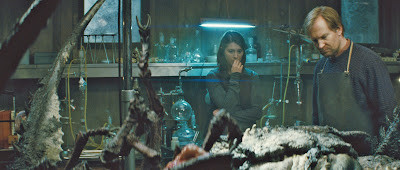
So Dr. Birack brings his students and a lot of equipment to the church. They’re joined by the priest, a biologist and his students, and an expert in ancient religious texts, whose job it will be to translate a book found next to the cylinder - a book written in a mishmash of Greek, Latin, and Coptic, passages erased and overwritten, over the course of centuries. They’re going to try and find out exactly what this thing is.

In style and subject matter, this film is pretty much a homage to the works of Nigel Kneale, who trafficked in similar territory in his own work. Some of it isn’t even subtle - one of Dr. Birack’s students is a transfer from “Kneale University” and the screenplay is credited to the pseudonym “Martin Quatermass.” I’ve seen some of Kneale’s work, and a lot of it is somewhat dated, but it’s still interesting in how it merges the scientific and the supernatural in really compelling ways. I don’t like the idea of remakes, but I would purely love to see Ben Wheatley tackle a remake of Kneale’s The Stone Tape. And that’s one of the best things this film has going for it - it’s an approach to the idea of supernatural evil that you don’t see very often. You’ve got a 2000-year-old religious text that contains differential equations and describes Jesus of Nazareth as a member of an extraterrestrial race tasked with imprisoning the occupant of this cylinder, with the idea that evil is a material thing, describable in terms of biology and physics. Strange dreams of future events, beamed directly into people’s brains as a stream of tachyons. In the news, the light from a supernova that occurred millions of years ago is just now reaching Earth. The sun and moon are both visible in the sky. Insects are going crazy, and people are starting to congregate around this abandoned church. As Lovecraft would put it, the stars are right.

So when it does work, it’s creepy and atmospheric, creating a feeling almost from the get-go that something very bad is coming, that events millennia in the making are gaining momentum. It doesn’t lean into many of the usual cliches about things like demonic possession and creates a pretty interesting visual vocabulary for itself in the process. It doesn’t always make a lot of sense if you look at it too closely, and not everything is explained, but I think that this actually helps it - we’re dealing with something beyond our comprehension, so of course it isn’t all going to make sense.

But there are parts that don’t work all that well, a lot of it (though not all) being a function of time. None of the characters are especially developed as people, and there’s a lot of them so after a bit they come off as kind of interchangeable. The dialogue is clumsy throughout, and the performances range from good and understated to wooden. Some of them are barely performances, not through any fault of the actors, but just because there are so many people that most of them barely get any time to develop at all, so there’s not much sense of who they actually are. It’s sort of hard to care about what happens to them as a result.

And in the moment to moment interaction, it really shows its age in terms of how it handles gender. Attitudes toward women in this film aren’t great, more chauvinistic than misogynistic, but it’s just obnoxious enough to be noticeable. In this building full of scientists and experts, the women are pretty much discussed entirely in terms of how available they are, and it’s off-putting enough to be a distraction, and the clunky dialogue doesn’t help. For a film that’s supposed to be about science trying to understand the supernatural (or the supernatural as phenomena that can be scientifically explained), it…doesn’t spend much time on the science, and the jargon doesn’t really hold up. I mean, it’ s not Star Trek levels of technobabble, but it feels at several points like an afterthought - all of these experts gather at this church and then sort of…go into different rooms and have conversations, so we don’t really get a clear picture of how science explains this thing. It sort of comes up in passing here and there, but it feels like understanding the artifact and the implications of its existence should come first, and then things should start to go south, and it doesn’t really work that way. It’s sort of scattered in what story it’s telling.

And that’s the other big problem - the pacing. It starts off strong, creating this atmosphere of looming dread, and it ends pretty well as everything goes to shit, but the middle sags quite a bit. One thing Kneale’s stories do well is create a sense of discovery, where you’re finding out along with the characters what it is they’re dealing with, and here we’re sort of shut out of that part of the story, and it suffers as a result. It’s not a very dynamic film at all, and that weakens the third act and threatens to bring the second act to a screeching halt. I suspect some judicious editing would tighten things up a bit, and I don’t think it’s just a matter of modern sensibilities preferring faster-paced films. I like a good slow burn, but this film’s missing the sort of things that would make for a good slow burn - establishing the people, gradual reveals of what they’re dealing with, mounting dread as everything builds toward a climax. Here we have an assortment of scenes put together that don’t really gel after the very promising first act.

But at the same time, when it works (and there are definitely moments when it does), it works really well. The effects work still mostly holds up, and even when it doesn’t it’s not egregious. It’s easy to overlook the technical shortcomings because it’s often in service of vivid, creepy setpieces. The cinematography is functional - solid without being flashy (with the exception of some inventively unnerving dream sequences), everything scored with ominous, pulsing synthesizer, and it ends on a strong, nicely inconclusive note, which redeems it to a degree.

So I think what we’re left with is something ambitious, trying to do something beyond the obvious, something that starts strong and ends, well, pretty strong, but really bogs down in the middle and doesn’t have performances that can carry it past the pacing problems. Which is too bad, because the idea of evil as a function of particle physics and ancient creatures from beyond the stars alike - that place where science and magic blur and become indistinguishable - is strange, fertile territory for exploration. And it’s been too long since anyone journeyed there.

IMDB entry

Available on Amazon

Wednesday, February 9, 2022

The Block Island Sound: Still Waters Run Deep

Sometimes it’s hard to think of horror films like other films. Genre filmmaking in general skews toward cliché, toward hitting anticipated (if not outright demanded) beats, neglecting things outside of the expectations of the genre. I don’t think subtext is an intentional product, I think it’s emergent from choices made by people making the film, whether they’re aware of where those choices are coming from or not. Like, if a choice makes a particular scene scary, why does it make it scary? What assumptions lead to “this is scary?” That’s where things like time, place, and culture come in. That way, even some of the hackiest genre filmmaking can still tell us something about the conditions that produced it. But sometimes it’s just so pro forma, so mechanical, that no sense of the impulses that drove it escape. I feel like it’s been awhile since I saw a film with interesting subtext, is what I’m saying.

Which brings me to The Block Island Sound. I don’t know that I’d call it especially scary. It’s low-key, certainly unsettling, with a real air of tragedy to it. And a lot of this tragedy comes from the ways it depicts the costs of masculinity.

It’s the story of Tom Lynch, and his son Harry. They live on Block Island, just off the coast of Rhode Island. Tom’s a fisherman, his wife died some time ago, and his two daughters got off the island as soon as they could. Tom probably drinks a little too much, and as the film opens, Harry’s starting to wonder about his dad, no matter how many time he gruffly insists that he’s “fine.” Tom’s becoming forgetful, he’s losing time, blacking out. He wakes up on the boat in the middle of open water, everything in disarray, no idea how he got there.

When nobody else is around, he hears a deep, monolithic growling.

This ends badly for Tom, and the majority of the movie is the story of how Harry and his sister Audry - back on the island doing some work with the EPA - deal (or don’t) with Tom’s death and what seems to be Harry beginning a similar decline. There’s a lot of weird stuff happening on the island, unusual amounts of dead fish washing up on the beach, birds dropping dead right out of the sky, electrical interference. And Harry’s starting to hear something growling out in the dark. But for the majority of the film, this is all sort of going on in the background, with Harry’s gradual disintegration (and denial) making it harder and harder for him to lead a normal life and adding strain to a relationship with his siblings that already wasn’t great. It’s as much a family drama as anything else. And in a lot of ways, that’s a good thing - I think scary movies are often better when they take the time to make their characters feel real and human. Maybe sympathetic, maybe not, but like you’re watching actual people, so when things start getting dark, there are real emotional stakes.

But in this case, I think the tradeoff is that the film never really kicks into high gear. It’s more sort of a steady climb - it moves forward, but does so in understated fashion, and I think as a result important narrative moments, important beats where things should feel like they’re escalating, don’t really land with the power they should. The more powerful moments, really, aren’t the supernatural ones, they’re the natural ones. The characters in this film are people, drawn at human scale - even the really annoying conspiracy nut who opens the movie somewhat inauspiciously (though to its credit, his little introductory rant doesn’t really explain what’s actually happening like I thought it would - he’s just as wrong as everyone else), three siblings who don’t get along (and don’t get along in a way that’s believable), small-town folks with their petty jealousies, and well-meaning outsiders who don’t quite get it, This all sets the stage for something more powerfully sad than scary. Tom and Harry as perfect examples of a certain kind of man - stoic, self-sufficient, not at all willing to ask for help or even admit that they need help. And this is ultimately the tragic heart of the story - the Lynch family are basically decent people with their problems, just like everyone else, surrounded by people who are in their turn flawed in one way or another, who in one way or another let them down. All of what follows could have been avoided if Tom had just spoken up, hadn’t refused to admit something was wrong, and lives are lost because of it/

When the supernatural does kick in, it’s mostly at that same measured, understated pace. The film does a lot of its work in hallucinations and dream sequences that are well-done, and don’t really overexplain or go too big and loud, but like the film as a whole, staying at a simmer throughout means it never really comes to a boil.  It’s not totally static, but even though there’s movement, it’s sort of the same stuff over and over again, only getting a little worse each time, so this contributes to the sort of flat feeling of the rest of the film. Hackles never really get raised, and the ultimate payoff is more cerebral than visceral. It’s well-done, recontextualizing some dialogue from earlier in the movie in a way that brings the point home and it ends on a nicely inconclusive note which gives it sort of a lingering chill. But it’s like the film’s setting. It’s the flat, bright expanse of open water in daytime, churning seas at night, the overcast roads of a small island town in the off-season, night held back only by the lights of homes - gray, quiet, and enigmatic. Ultimately, the sea keeps its secrets.

IMDB entry

Available on Netflix
Available on Amazon

Wednesday, February 2, 2022

Housewife: In Dreams, I Walk With You

I appreciate a well-crafted narrative as much as anyone, both because a well-told story is engaging for its own sake, and it because it can be enjoyable to appreciate the craftsmanship that goes into it. And you don’t always get that in horror film. Genre filmmaking is vulnerable to a reliance on cliché and timework expectations in general, and I think horror films are especially vulnerable to this - it’s very easy to make a commercially successful film that neglects character, mood, and skillful narrative in favor of cheap shock. And plenty of folks like that, but…I dunno. It feels like empty calories to me. So I like it when filmmakers actually make horror films that are actually films.

But…that’s not really what I’ve come here to talk about today. Today, I’ve come here to talk about films that concern themselves less with character and skillful narrative and more with just grabbing you by the collar and telling you to strap in because you are about to go for a ride. The kind of films that you just let wash over you.  

Housewife is very much one of those films, a striking combination of Dario Argento and David Cronenberg, a film more felt than thought about, a film that says pretty much from the start “hang on, because you are in for some weird shit.”

It begins with a big, old house, and a room with a shrine, dominated by a painting of a stern-looking woman, another woman praying feverishly to the picture. Elsewhere in the house, two little girls - sisters - stay inside their bedroom. They have to stay there when their mother is talking to “the visitors.” The older of the two discovers that she’s begun menstruating, and unsure of what’s happening, she calls for her mother. When her mother sees what has happened, she…well, she begins wailing in anguish. Acting like this wasn’t supposed to happen. Which isn’t encouraging. She tells the younger girl to stay in the bedroom, close her eyes, and play a counting game. She does, and counts, and keeps counting, and keeps counting. Her mother doesn’t come back. She opens her eyes to find the bedroom door open, so she walks out into the hallway, follows sounds of splashing…

…only to discover her mother drowning her older sister in the toilet.

The little girl is Holly, and both her sister and her father die that night by her mother’s hand. We don’t know why. We fast-forward to Holly’s adulthood. She’s married to a painter, Timucin, and they’re trying to have a child. Holly’s childhood left its mark - she really, really doesn’t like using toilets. But she and Timucin seem okay otherwise. And then an old friend - well, more than a friend - comes back into their life. Her name is Valery, and the three of them used to share a small place in New York, as well as a bed. Holly’s a little upset that Valery’s just shown up after two years of being incommunicado, and you get the sense that maybe this unconventional relationship didn’t end happily. But she’s here now because she’s in town for a seminar being held by a group called The Umbrella of Love and Mind. Is it a self-improvement workshop? Is it a cult that calls itself a “family” and teaches people to travel through the dreams of others?

Why not both?

So Holly and Timucin and a couple of their friends attend the seminar, and that’s where…well, it’s not where shit gets weird, because the whole thing starts weird, but it’s where it starts to get really weird. This is a film that is not really heavy on story or even plot - it sort of sets things up and then once the pieces are all in place it just starts stuffing imagery and ideas into your eyes in a way that’s engaging, even if it doesn’t always make clear, linear sense. In some ways, it’s very artificial - especially in the dialogue, which is stilted in a way that suggests it was translated or written by someone who wasn’t a native English speaker. I was actually sort of surprised that it wasn’t subtitled like the director’s previous film. This doesn’t help the narrative’s coherence, but what we lose there we gain in a pervasive strangeness. The characters aren’t explored in-depth, but they feel like people, and the relationship between Holly, Timucin, and Valery is communicated as much by showing as telling - details come out eventually, but well before that how the three of them interact gives you a pretty clear picture of who they were to each other. It’s a relationship that feels lived-in and intuitive. Other characters are less fleshed-out, but it doesn’t matter so much because once the table’s set, with Holly being singled out by the group’s enigmatic leader, Bruce O’Hara, it hurtles deliriously toward the end.

The film takes a lot visually from the work of Dario Argento - there’s a real giallo vibe to the cinematography, with lots of people in stylish, aggressively modern settings contrasted with flashbacks and dream sequences shot in soft focus, lighting heavy on reds, blues and golds, There’s a real dreamlike surrealism to these sequences that contrasts nicely with the stuff happening in the present and waking world, and the acting often has the same sense of operatic intensity you see in Argento’s work. This isn’t a naturalistic film, it’s stylized with distinct visual sensibilities used to locate parts of the film either inside or outside of the present and the real, establishing and then subverting the difference to good effect.

The story isn’t necessarily one that Argento would tell, though - narratively, it takes its cues from the early work of David Cronenberg. The meeting that Holly and Timucin attend has the same blandly sinister vibe present in Videodrome, that same intersection of salesmanship and showmanship putting a friendly face on something very dangerous. What the group does - “dream surfing” that allows them to walk around inside another’s subconscious - isn’t that far off from the strange psychology of The Brood or Scanners, and the nesting doll of a narrative, where dreams and reality commingle freely, isn’t that far off from the simulated worlds of eXISTENz. It doesn’t feel like plagiarism, just a lot of the same vibes and ideas put together for a different purpose, expressed with a distinct visual palette. This film doesn’t concern itself with Cronenberg’s questions about the relationship between biology and technology, or technology and autonomy. It has its own ideas about the new flesh, and as the film goes on, it moves from the psychological horror that you get when the line between the conscious and subconscious start to blur into the body horror of pregnancy and birth, ending on a startling note of cosmic horror that lingers just long enough for its punch to remain intact.

A lot of this recalls the director’s first film Baskin - the pervasive dreaminess sharply contrasted with gruesome, bloody imagery, the feeling that there’s something going on just outside of our awareness, the feelings that there’s more to this story than we’re getting. Like that film it doesn’t always make a whole lot of sense, but also like that film there’s a real sense of vision at work here, and this one feels more strongly realized, more self-assured than the director’s debut. It’s very much one of those films that you have to let wash over you and experience, rather than think too closely about - if you stop to think about it for too long, it kind of falls apart, but if you go along for the ride, well, it’s a hell of a ride. When the credits rolled, I sat up and said “DAMN!” out loud in the privacy of my own home, and that isn’t something that happens very often at all.

IMDB entry

Available on Amazon 

Wednesday, January 26, 2022

Archive 81: Terra Incognita

 Awhile back, I wrote about a couple of horror podcasts I was enjoying, and discovered that one of them - Archive 81 - was being developed as a series for Netflix. I was happy to see this, added a placeholder to my list and then promptly forgot about it. So it was a pretty pleasant surprise when it popped up in my queue a couple of weeks ago. The podcast was definitely something off the beaten path - I think I described it as what might happen if the directors of Resolution and The Endless decided to do their own take on the whole SCP mythology in the style of Radiolab. Which is just…so many different references to track. But it largely worked, by turns unsettling and surprisingly touching, with excursions into both Lovecraftian cosmic horror and a somewhat more benign strain of dark fantasy.

So I was excited to see how it’d translate to a visual medium, if a little cautious. The source material is kind of convoluted, a narrative nesting doll where you’re listening to recordings someone has made of their experiences while listening to an entirely separate set of recordings, and it’s all framed as being presented by a friend of the person who was listening to these recordings and has now gone missing. That’s a lot. Also, just to get my own biases out of the way, one of the executive producers is the same person behind a number of slickly-produced, highly commercial horror franchises, the kind of stuff I generally don’t like. I was a little worried that this is would end up being another example of what film critic Mark Kermode calls “quiet quiet quiet quiet BANG!” filmmaking. All jump scares, no atmosphere.

Fortunately, what we get is nothing of the sort. It’s brooding, sinister, and works in areas of horror that I don’t think get enough attention and are absolute catnip to me. It does have some pacing problems, and not everything lands as well as it could, but in general it’s spooky and atmospheric as all get-out.

It’s New York City in the modern day, and Dan Turner works as a film conservator for the Museum of the Moving Image. He has a real affection for old films and television shows, ephemera in danger of slipping through the cracks of our culture. He’s a quiet guy, very private. He had some bad stuff happen to him as a kid, and he’s had his struggles with mental health. There was a relationship, but it’s over. But when we meet him, he’s on his way to work, seeing if a sidewalk vendor has any interesting old VHS tapes. He gets to work and a couple of important things happen in short order. First, he finds out that the museum has acquired the footage for a never-aired horror anthology show called The Circle, something that’s been a bit of a holy grail (or white whale) for him, and second, that someone wants to hire him away from the museum for a year to work on a special project.

The project is to restore a series of damaged videocassettes retrieved from a fire at an apartment building in the mid-1990s. He’ll be working at a corporately-owned research and storage facility up in the Catskills, far away from the hustle and bustle of, well, anywhere. He’ll have living space, anything he needs delivered to him, and $100k for a year’s work. Dan consults with his good friend Mark, and takes the job.

The first thing Dan discovers is that the cassettes are recordings made by a graduate student named Melody Pendras. She was working on an oral history of the Visser Building, an apartment building in Manhattan, and the cassettes are her interviews with residents in the building. At least, that’s what they are to start. The longer Melody is there, the more she starts to notice things - the secrecy of the residents, a sixth floor that’s only accessible via a locked button on the elevator.

Strange singing and chanting coming up through the vents in the middle of the night.

The first smart thing this adaptation does is strip away a lot of the narrative convolution of the podcast. We have two central points of view in this series - Melody, as she discovers more and more about the history of the Visser Building; Dan, as he discovers more and more about the facility where he’s living and working (and the company that owns it), and then there’s the place where these two points intersect, mostly described through segments of Dan restoring and watching Melody’s tapes, at least to start. The shifts between perspectives are also shifts in time - Melody in the past, Dan in the present - and so at points the series plays with chronology by showing us the end of a series of events via Dan watching a recording, then showing us what lead up to it from Melody’s point of view as it’s happening. It’s all handled skillfully and rarely feels confusing, which is good because as it goes on, the division between these two perspectives starts to get thinner and thinner. The broad strokes are that this is a story about two people going down two different (or are they?) rabbit holes at two different points in time.

And the deeper Melody and Dan go, the darker and stranger things become. It takes awhile for things to ramp up, and the first half of this eight-episode series is characterized more by a persistent low-level feeling of uneasiness and paranoia than anything else. At times, there’s a circular feel to it - points get brought up and then abandoned, only to be revisited or recontextualized later. Sometimes it works, giving everything a slight dream-logic feel, like these images or ideas are important, but their specific importance or meaning continue to elude us. But, other times it feels like we’re getting some reveals earlier in the story than we should, and it threatens to undo some of the mystery. I’d say that at worst, there are spots over the eight episodes that feel like the story is spinning its wheels a little and sometimes the narrative gets a little jumbled. A story like this benefits from a feeling of unfolding, or of events escalating, and there are tangents and side trips that undo that momentum a bit and can feel a little like stalling.

But then starting with the fourth episode, things begin to pick up. The story does a good job of introducing new bits of information throughout that change how we perceive Melody and Dan - there’s more to her trip to the Visser than just a research project, and Dan wasn’t necessarily chosen for this job solely for his skills as a conservator, so within any given episode, there are new revelations which piqued my interest even when the broader narrative fumbled a little. The show keeps a lot of balls up in the air, in the form of repeated images and names and places and ideas, some of which pay off right away and some of which don’t pay off until the very end, but do pay off. As it progresses we learn more - about Dan, about Melody, about the Visser, about what happened all those years ago, and what’s going on right now. It might not always come together as neatly as I’d like, but it does come together in a largely satisfying way.

What it does really well, though, is set a mood, doing so through the use of locations, using what at first seem like fairly mundane areas to create a feeling of unease. This is very much a show about navigating a location and unraveling its secrets. I’m reminded of a dream that I had when I was younger, where I opened a cabinet in the basement of my childhood home and inside was an opening to a vast chamber that couldn’t possibly fit within the house, as if I’d opened a door to another world entirely. That feeling permeates this show. It’s like a more sinister riff on the idea of Platform 9 ¾ from the Harry Potter books or the crawlspace that opens up into John Malkovich’s head. Someplace utterly mundane extended into something otherworldly. The compound in the Catskills seems at first like a somewhat musty corporate facility, obviously bought in the 80s or so, but the longer Dan’s there, the more he discovers - basements, sub-basements, hallways hidden behind walls, so over the series the compound starts to sprawl into something much larger and labyrinthine than it first appears, while always maintaining its sense of bland institutionality. Long, dimly lit hallways lined with storage rooms, the files and media contained on the shelves within all pointing to some terrible mystery. The whole thing has the inherent spookiness of an empty office building late at night, spot lighting casting pools of light in the seas of shadow,

Likewise, the Visser seems to sprawl upward and downward at the same time - it’s all wood details and bland drywall in the residential areas and cinderblock and concrete in the stairwells and utility areas. The community room is beige carpeting, a bulletin board, plastic chairs. Everything looks perfectly normal, but there’s too much of it, and there are areas that are off-limits - the sixth floor is only accessible by elevator key, nobody’s allowed in the basement, so many secrets hidden behind the plainest of doors. There’s a history to this building, to the land on which it was built, and there’s a sense that whatever was there before the building was constructed has…infected the building somehow, an idea that becomes disturbingly literal at points to good effect.

I’m really pleased to see this explored - this idea of uncanny spaces, locations that look mundane on the surface but reveal greater strangeness the further you go, doesn’t get nearly as much attention in horror as I’d like, so I’m always happy to see it done well. On the other hand, as good as the persistent paranoia is, I don’t think it’s always calibrated as well as it could be. The further we get into the story, the more Dan and Melody discover, the harder it is for them to act like nothing’s wrong, but when the other shoe drops, it drops loudly. Lots of screaming and freaking out in front of people our protagonists should know better than to freak out around. There’s something to be said for depicting the horror of discovery quietly, at having to keep up appearances knowing what you know. There were times, especially in the second half of the series, when I found myself wondering why Melody and Dan couldn’t just keep their mouths shut, and it was a little distracting.

But then again, in addition to the idea of exploring mysterious, impossible spaces, there’s a layer of mystery on this show associated with forgotten media as well, which is another one of my favorite things in horror. The idea that in storage spaces and rummage sales and sidewalk vendor trays, there are things with vast secrets waiting to be discovered. Forgotten books and the grainy film footage of a television show that nobody ever saw. Films of horrible things, screened to a select audience in a secret bunker. Dan restores a set of tapes rescued from a fire, another set of tapes document the work of someone who was cataloguing hours of soap opera footage and slowly went insane, a suggestion that there’s this whole strange world just underneath the skin of this one, waiting to be discovered, This is absolutely my shit, and again, I’m pleased to see people working in this mode and doing so with skill. It beats the shit out of possessed dolls and the ghosts of evil nuns.

In terms of the overall tone, of the show, the word that keeps coming to mind is “subdued.” Performances are mostly low-key and quiet (with some exceptions - some that work, some that, as I outlined above, don’t work as well). We get to know more about most of the characters as the story goes on, and they’re all mostly recognizable as actual people instead of caricatures. The soundtrack is equally understated, consisting most of either diegetic songs (lots from the mid-90s) and a score dominated by ambient music, electronic hums and swells and the sound of audio interference. The cinematography is cold and desaturated in the modern day and warmer and more colorful at the Visser, which helps underline the narrative shifts between Dan witnessing things via tape and Melody experiencing them in real time. There’s very much a through-line that these are two people trying to connect across time and space, and the show does a good job of teasing new information in a way that slowly reveals the scope of what’s happening. Things connect in unexpected ways, things that come up briefly early on come back later as significant pieces of the puzzle, and in the end it’s all made clear, ending on an impressively inconclusive note that, if you’ve listened to the podcast, will give you some idea of what might come next.

And that’s what I’m wondering, where it’s going to go from here. I liked what I saw enough to want to see a second season, if only to see how they handle what comes next in the podcast. Here, they’ve taken the first of three stories and expanded it beyond what happened in the source material. I remember the segment about the Visser Building being the briefest of three stories, and the team behind this show did a good job of fleshing it out into a fuller story, so I’d be interested to see what they do with the far stranger and wilder territories that lie beyond the Visser Building, and I hope we get a chance to explore them.

IMDB entry
Available on Netflix
Podcast homepage

Wednesday, January 19, 2022

The Old Ways: Coming Home

I have to say, I tend to approach any film that has “characters travel to another country and get menaced by primitive, superstitious natives” with a certain amount of trepidation. There are ways to do the tourism-gone-awry angle well, but it’s also really easy to do it poorly. It’s really easy to conflate fear of the unknown with fear of the other, and if the other is distinguished in terms of race or class or nationality, well…if not handled carefully, it can get icky. It’s not impossible subject matter, but it’s not easy either, and call me a snob but I don’t really trust the kind of movies going straight to streaming to handle it with aplomb.

Well, much to my relief, The Old Ways manages to handle its premise well on that front, and ultimately it’s much more about recovery, identity, and belonging than anything else. Unfortunately, there are some pretty big narrative missteps, and the substance threatens to be drowned out by those poor choices. As often as not, it’s sort of muddled and formulaic.

Cristina is a reporter who’s traveled to Mexico to write a piece about the people of a small village deep in the jungle. In the course of her investigation, she travels to a local cave called La Boca to look around. The problem being that La Boca is a taboo place that her local contacts warned her not to visit. She did anyway, and this is why as the film opens, following a brief flashback, we jump right to Cristina in a room, bound, with a bag over her head.

The locals believe she came back from La Boca with something inside her. Something that needs to be...exorcised.

This film makes the interesting choice to get right into the action and to develop Cristina and the story of what brought her here in flashback, over the course of the movie. I don’t hate this choice - it’s certainly a departure from the formula - but in the execution I think it ends up having some drawbacks. Part of the problem is that because Cristina starts off as sort of a blank slate, the revelations about her don’t have as much impact as they could. We don’t know anything about her to start, so there’s no expectations to reverse or things to recontextualize. That the information is mostly communicated through straightforward exposition doesn’t help either. For example, she’s a really good reporter. How do we know this? Well, there’s a scene where she reminds her editor that she’s a really good reporter. It doesn’t really paint a picture so much as just tell you what you’re looking at.

But the biggest problem on this front is that Cristina starts off highly unsympathetic. I think films like this work best when we identify with the protagonist and want to see them escape danger, and here we have a hotshot reporter who goes where she’s told not to go, and who defends her decision to do the exact opposite thing she was warned against doing with what is essentially “I wanted to do it.” Now, there’s a reason for all of this that makes perfect sense once we have more information, but in that moment, it reads like she’s a spoiled, willful kid who’s about to pay the price for her thoughtlessness, and so it’s harder to invest in her. This is compounded by the revelation that she has an opiate addiction on top of everything else, This revelation is actually handled pretty well and is addressed throughout in a pretty understated fashion, which works well and becomes a more important piece of the film as it goes on. Which is all to the good eventually, but it also means that for the first half of the film she pretty much has two modes: “shouty” and “dopesick.” By contrast, her captors are hardly malevolent at all - sure, they’re holding her captive and her accommodations aren’t great, but they don’t brutalize her, and so there’s this weird reversal where the antagonists seem more sympathetic than the protagonist, culminating in something around the halfway point that should be read as “heroine makes a daring bid for escape” but ends up coming off more like “obnoxious tourist commits assault.” It marks a turning point for the film, and what follows is largely better and more thoughtful than what came before, but it’s off-putting.

Following this, then, the tone of the movie (and of the protagonist) shifts, and here’s where Cristina’s drug addiction fits in - it’s never really signposted or made too obvious, but this shift suggests that what we’ve been watching all along is a metaphor for addiction - the idea of an all-consuming need that feeds on pain and despair, denial, hitting bottom and realizing what you’ve become, and then turning to something better, including making amends and being of service. To the film’s credit it’s never made blatant, and it gives it a bit of thematic heft, which it sorely needed. And as possession-as-addiction metaphors go, it’s handled well. And as we learn more about Cristina, from this also comes some interesting stuff about identity and belonging and who family is as well. But I feel like the choices made in the first half of the film - how Cristina is portrayed, not having a fuller picture of who she is outside of what’s revealed - mean the back half of the film doesn’t have the emotional impact that it could have had. Mostly there’s just relief that Cristina isn’t so relentlessly awful anymore.

Apart from some of the unfortunate characterization, this film never really develops much of a mood, either. The things that are supposed to be scary are so rote that you never don’t see them coming, and it’s not especially inventive in its imagery. It’s kind of demonic possession 101 - there are nightmare sequences, mysterious figures lurking outside, stuff moving around in the shadows, strange things getting vomited up, and you can see it all coming a mile away. Things do improve somewhat on this front as well in the second half of the film, adding some tension to the mix, but it’s sort of too little too late. And then just when it feels like it’s getting good and is going to stick the landing, the ending - which I think had the right idea in its broad strokes - goes on far, far too long and throws in some dopey “badass Final Girl” cliches for good measure. There’s a good movie in here somewhere, a thoughtful, understated, unsettling movie about where home really is, about finding where you belong. But, like Cristina, it’s lost in something else.

IMDB entry
Available on Netflix
Available on Amazon

Wednesday, January 12, 2022

The Thing (2011): That Which Should Not Be

(Note: If you haven’t seen John Carpenter’s remake of The Thing, go remedy that immediately, then come back and read this. because I’m probably going to lightly spoil that film, and it’s excellent.)

I have a sort of quasi-tradition where I try to make a point of watching John Carpenter’s remake of The Thing after the first real snowfall of the winter. It’s one of my favorite horror films, and goes perfectly with the freezing cold and snow piled high outside. Well, the first snow we’ve had this winter was pretty anemic, so it made perfect sense for me to take a look at the 2011 prequel to that film, which also shares its title.

Okay, that’s kind of a cheap shot, but honestly, I think it’s a fair summation. The Thing (2011) shares some features with the film it simultaneously precedes and follows, but it’s all in surface details and it misses a lot of what makes its inspiration so good.

We start off with a bunch of Norwegian researchers at Thule Station, in Antarctica. They’re out for a drive, swapping dirty jokes, running some kind of errand, when their vehicle crashes into a crevasse in the ice. A crevasse which, at its bottom, holds what appears to be some kind of enormous, well, let’s just say it - spaceship. They find a UFO in the ice. Following their rescue, the crew of the station surveys the site, and some distance away from the craft, finds something else under the ice…a form.

Something that doesn’t look human, and does look like it was crawling away from the wreckage.

Right off the bat, this film’s an odd duck. It’s clear that it got made on the back of John Carpenter’s film, in the way that the inevitable churn of sequels and remakes and reboots seek to capitalize on the nostalgia we have for the original films. But it’s not a remake, per se, or a sequel - it’s a prequel, and one that is clearly trying to hew faithfully to elements of the original film. And it’s a prequel with a built-in narrative hook, in that it’s telling the story of the Norwegian camp that the protagonists of the original stumble upon early in the film. In the original film, we see aftermath, and here, we see those events as they play out. So it’s not a case where someone’s had to gin up an origin story or a reason for some antagonist to come back, it’s a story that takes place in a natural narrative context. Carpenter’s The Thing begins with a helicopter containing two Norwegians flying into their camp, shooting at a dog that they appear to be chasing. That’s what starts everything in the first film, and so here what we’re getting is everything that lead up to that moment.

And this was my first problem with the film - it’s telling a story that didn’t really need to be told. The sequences in the Norwegian camp in the first film were highly effective on their own, no elaboration necessary. I mean, it’s a less contrived addition to the story than a lot of sequels or prequels are, but sometimes less is more, and not knowing exactly what happened there was a lot creepier than knowing would be, especially since anyone who’s seen the first film has a pretty good idea of what probably happened there. In that sense, it’s a film that isn’t really telling us anything we didn’t already know. But even so, if it’s a well-told story, it could at least keep us engaged, even if we do have a pretty good idea of where it’s going and how it’s going to end. But that’s the next place it falls down - this is a film that knows the details of the first film well, but not why the first film was so good.

There were a couple of things that made the original as effective as it still is. First, the first film is ultimately more about people than the monster, the extraterrestrial that’s come into their camp and is assimilating everyone in the station, one by one. The monster is the instigating force that gets the men to turn on each other, since any one of them could be infected, but that’s really its central purpose. The majority of the original film is a story of paranoia and distrust, and how the already-contentious relationship between those men lead to their deaths. The monster only really shows up to reinforce their paranoia, to remind them it could be anyone or everyone, and that it would be extremely bad if it got loose. The characters in the first film aren’t necessarily explored in depth, but they’re distinct people with their own personalities and their own humanizing touches, so we’re invested in seeing what happens to them.

Second, when it does address the monster, it leaves a lot to the imagination, because the limitations of special effects at the time required it. For every vivid, well-lit instance of some horrible mutation, there are two or three of things barely glimpsed on-camera, or attacking from the shadows, and again, no special effect is ever going to be as horrifying as what you can cook up in your head. It’s pretty much all achieved through practical effects as well, which makes the original feel grounded, and why the creature effects (though certainly not flawless, and some are pretty dated at this point) are so disquieting - it’s something physical, it’s inhabiting the same space as the actors, but it’s so alien in design that we can’t quite get our heads around what we’re seeing. It’s as Lovecraftian as you’ll find outside of actual adaptations of Lovecraft.

This film, by contrast, invests a lot more in the monster than in the people. The protagonists in the original weren’t what you’d call fleshed-out, but they had distinct roles and personalities. In this film, you’ve got the leads and then…a lot of interchangeable Norwegian men. Half of them, I think, didn’t even really have names. Everyone’s an archetype, nobody has an inner life to speak of. We don’t really get to know them before the shit pops off, either. There’s a scene of a bunch of them drinking and singing, but that’s kind of it. We learn a lot more about life at the station in the original before things get really bad, and it makes a difference - there’s enough of a sense of them as people that the paranoia carries some weight once they realize what’s going on. Here, they’re mostly just…cannon fodder. And the monster begins its predations much sooner and in a much louder fashion than in the original. Yes, there are nods to the idea that they can’t trust each other, but here those moments really just serve as interstitials between monster attacks, rather than being what carries the film. So, even though it doesn’t end up being quite as rote as it could be, it comes close at many points. We don’t know these people, so we don’t care about them, and whether one of them has been assimilated or not is reduced to a guessing game, signposted by sequences that inevitably end in yet another gory reveal. You could almost set your watch by it.

And the monster in which they invest so much is a lot less effective than it is in the first film. The monster is clearly and plainly depicted, on-camera under well-lit conditions for extended periods of time. It’s clear that the filmmakers did their homework and tried to stick as closely to the design of the original creature as much as possible, so it’s at least a good design, but it’s also pretty clear that what we’re seeing is almost entirely digital effects. It’s not terrible CG work, but it’s also clear that that’s exactly what it is, and so all of those moments (and there are a lot of them) have an artificiality that the original film didn’t, and in some ways it makes the monster less frightening. I mean, it’s certainly gross, all waving tentacles and mouths where you wouldn’t expect mouths to be and limbs in equally unexpected places, but it never feels as real as the practical work did in the original film. So what we’re left with is a bunch of people we don’t care all that much about alternating between creeping around, yelling at each other, and shooting or burning creatures, and setpieces where an obviously-artificial monster chews on them in various disgusting ways. In some ways, it’s the more action-oriented Aliens to the original film’s slow-burn Alien, but the characters in Aliens had way more personality than these poor bastards do, so what we get is less a story and more a series of beats that happen in mostly-predictable sequence.

Otherwise, this film can best be described as competent, with a good eye for detail in terms of the original film. The acting is fine, nothing nuanced but nothing wooden or cringeworthy either. and the dialogue is perfectly serviceable, without being awful. Everything is well-lit and clean, which takes some of the atmosphere out of it. But the setting closely resembles the original sets from the original film, and everything plays out in a way that slots neatly into what the protagonists of the original film discover. If anything, one of this film’s bigger strengths is the degree to which it honors the source material (at least until the very end, which takes a goofy and unnecessary detour into the original spacecraft). The music cues call back to the score of the original, even the font for the credits and the animation for the opening title. So the filmmakers are at least respectful of the original and its legacy.

But the question remains: Why do this at all? The story of the ill-fated Norwegian camp was certainly untold, but does telling it really add anything to the original film? And if you haven’t seen the original film, well, now you have a pretty good idea of what you’re in for when you watch the original, at least in the broad strokes. I don’t necessarily blame the filmmakers for all of this - apparently, the director was so beset by studio interference that he swore he’d never work with an American studio again, and hasn’t since - but apart from being an opportunity to trade on the reputation of a much better film, there’s no reason for this to exist. This is the thing that should not be, largely well-executed but profoundly empty.

IMDB entry

Available on Amazon

Wednesday, January 5, 2022

L’Aldila: A Place Between

I’ve been doing this for awhile, and though my guiding principle has always been “write about the films you feel like writing about, when you feel like writing about them,” as time’s gone on I’ve started to recognize the importance of also paying attention to the breadth and history of the genre as well. Not that I’m gonna claim to be any sort of expert but increasingly I’m coming to feel like if I’m going to write about horror movies, I should probably be pretty literate in horror movies. And the longer I do this, the easier it is for me to see where I’m not as literate as I’d like to be. One of the biggest areas I need to work on is classic Italian horror films. They’re damn near a genre of their own, and having only seen Suspiria and Profondo Rosso, I’ve only begun to even scratch the surface.

So it’s sort of an ongoing project, and this week, that brings me to L’Aldila (The Beyond). In a lot of ways, this feels like something between the other film’s I’ve seen in this style. It’s not quite as bonkers narratively as Profondo Rosso, and it’s not quite as riotous visually as Suspiria, but I feel like I’m starting to get a sense of what the style is all about. I know I’m still barely into the canon, but I’m beginning to think that the word “subtle” is just…never going to apply to these films.

It opens on a flashback, shot in tones less sepia than deep, tarnished gold. It’s Louisiana in 1921, and a crowd of townsfolk are approaching a big hotel. This is intercut with someone inside, feverishly painting a blighted landscape, and a woman reading from a mysterious old book. The crowd breaks down the door, drags the painter from his room. We learn that this hotel is built over one of seven gates to Hell found on Earth. And then the crowd takes the painter to the hotel’s basement, whips him with chains, burns him with scalding pitch, and crucifies him to a wall. The book bursts into flames.

And then it’s Louisiana in 1981, and a young woman named Liza Merril is directing a renovation of the hotel. She’s inherited it, and she sees it as her big break, or last chance at some kind of prosperity and success. Oh, sure, there are problems - the wiring is faulty, the plumbing is completely blocked up, the exterior needs to be repainted, and the interior desperately needs an updating, and she has no budget to speak of. But she’s doing what she can to get the hotel up and running as soon as possible. Which makes the obstacles that much more frustrating, like the workman who falls off a scaffold after glimpsing something inside the hotel.

Like the plumber breaking through a wall in the basement, into where the painter was crucified. And the dead, beginning to walk.

There’s really not much of a plot to this film, beyond “woman inherits old hotel in New Orleans, and as soon as the remodeling begins bad shit starts to happen.” That’s pretty much it. There’s very little character development to speak of, although at least this time the sexism isn’t quite as pungent as it was in Profondo Rosso, and the film sort of moves from one scene to another without a lot of narrative contiguity. Here’s the setting, here’s the cast, now here’s a lot of mayhem. But somehow, it works better than it should, and I think a lot of that is down to an atmosphere of persistent strangeness driven both by deliberate choices and by the byproducts of the type of film it is. It’s an Italian production set in the U.S., and to their credit, it looks like at least some of the film was shot on location, which was more than I was expecting. But as a result, the acting and dialogue are all extremely stilted in that way you get when everything’s dubbed. Almost everyone in this film is a little off in one way or another, even if it’s only in that they talk and act like people do in films set in a specific place but written and directed by people who only have a passing familiarity with that place. Even the blandest of characters, then, feel at least a little strange, and some, like the hotel’s two caretakers, are right out of a gothic novel.

The nature of the production, then, helps create a vibe even if unintentionally. But it works because that vibe is only amplified by the intentional choices made by the filmmakers. This film doesn’t waste a lot of time, telling us within the first ten minutes that this hotel is built on top of one of seven doors to hell, and hitting the ground running from there. It’s a very no-nonsense, no-filler approach. In pretty much every scene, something weird or violent (or violently weird) is going to happen, and it’s got just enough of a throw-it-all-against-the-wall-and-see-what-sticks vibe to it that it does a good job of resisting predictability. Does it all make a whole lot of sense? Not really, though it’s at least thematically cohesive. Images reoccur in a way that might not make for a linear story, but do at least give the film a consistent vocabulary. Within setpieces, the rhythms vary enough (plus it’s all just so fucking weird anyway) that you don’t really see too much coming, and the filmmakers manage to keep some fun (if largely inconsequential) twists secret for the last act. Shots get held a little longer than you’d expect, the action moves more slowly sometimes, then more quickly at others. There’s a fair amount of graphic violence, and even though it’s all done very much on the cheap and that’s readily apparent, the very specific, personal nature of the violence (this director really, really hates eyeballs) means it’s still pretty squirm-inducing, even when it doesn’t look at all realistic. 

In some ways, this is a very impressionistic movie, more about evoking a feeling and using a fairly limited palette, heavy on the repetition of specific images and ideas, to sustain that feeling. It’s less stylish than Suspiria or Profondo Rosso, but individual shots and setpieces do evince some visual flair. One especially vivid moment sees a pool of blood (the consistency of a cherry Slushee) crawling slowly across a marble floor toward the feet of a young girl, but for every moment like that, you’ve got a bluntly depicted gore sequence, and though some are still very effective, some are downright laughable. It’s a much earthier, funkier movie than Suspiria or Profondo Rosso. Instead of stylishly modern apartment buildings you have a run-down hotel with a basement you can practically smell, and all of the graphic violence has a real tactility to it - bodies ooze and drip, blood flows and spills and runs, body parts squish. I wouldn’t call it art, and even when it’s risible it's still pretty fucking gross, but it’s intensely specific and personal.

This extends into the production as well. The camerawork uses a lot of quick zooms and pans to keep things tense, the editing uses a lot of sudden cuts to striking images (especially close-ups on pairs of blank, unseeing eyes) and extreme close-ups in the more violent scenes to keep things uncomfortable. Apart from the gross old hotel, some of the action takes place at a hospital whose interiors are stylishly modern and relentlessly white by comparison, and the contrast throws both into sharp relief. There are just enough establishing shots of New Orleans and the surrounding area to keep it from feeling too much like a film where one city is being played by an entirely different city, so it doesn’t feel as silly as it could. Like other film in the style, the soundtrack is mostly something akin to jazz fusion, all keyboards and uptempo drums and slap bass, which in some instances is innocuous, and in others (usually instances where someone is being dispatched in gruesome fashion) makes the whole thing feel even stranger.  The pacing is pretty good throughout until it hits a snag in the last act. It feels like the producers told the director to insert an entirely unnecessary chase sequence, and according to IMDB trivia, that’s exactly what happened. You can tell -  it drags on for entirely too long, and it means the protagonists have to mysteriously end up someplace else entirely, but the film still ends on a pretty striking note. It doesn’t quite have the impact it would otherwise because of the pacing issues, but  the imagery is still surprising and evocative.

I’m only three movies (and two major directors) in, but I think I’m starting to get a sense of what to expect when I go into films like these now, even if that sense is “shit’s gonna be weird, don’t think too hard about it.” I’m starting to see why this style of film is held in such high regard in some circles, and I’m looking forward to more.

IMDB entry
Available on Tubi
Available on Amazon